


You are typing an email at full speed when your finger skips a letter, and a red squiggly line pops up under a word you use every day. That small slip sits at the heart of the foward vs forward question. The short answer is clear: forward is the only correct spelling, and foward is simply a typing error. This guide explains why, with simple examples you can use right away.
Many writers wonder whether foward could be a rare variant or a regional spelling. It is not. Dictionaries in the United States and the United Kingdom list only one form, and every major style guide agrees. In the sections below, you will learn what the word means, where it came from, and how to use it as a verb, adverb, adjective, and noun. Settling the foward vs forward debate takes only a few minutes.
Is “Foward” a Real Word?
No, foward is not a real English word. You will not find it in Merriam-Webster, Oxford, Cambridge, or any other trusted dictionary. When writers search for the foward vs forward answer, the result is always the same: the correct spelling has the letter r after the first o, giving you f-o-r-w-a-r-d. Anything else is a misspelling that spell checkers flag right away.
The confusion makes sense because English has plenty of words with letters that are easy to skip. Your brain hears the sound and fills in the gaps, so a missing r goes unnoticed while typing. Still, using foward in a resume, school paper, or business email can look careless. Knowing that the foward vs forward choice has only one right answer helps you proofread with confidence.
What Does “Forward” Actually Mean?
The word forward means toward the front, toward the future, or ahead in position or progress. If a car moves forward, it travels in the direction it faces. If a team moves a project forward, it makes progress on the work. A clear definition like this helps solve the foward vs forward puzzle, because the meaning always points ahead.
Forward also has social and business meanings. In email, to forward a message means to send a copy to someone else. In sports, a forward is a player who attacks near the opponent’s goal. When someone is called forward, it can even suggest boldness. Understanding these meanings makes the foward vs forward choice easier, since only one spelling carries all of them.
Click Here To Read More Knowledgeable Articles
Grammar is a big subject, and one article rarely covers everything you want to know. If you enjoy clearing up confusing spellings, a good next step is to explore other word pairs that trip up writers, such as affect and effect, their and there, or lose and loose. Each pair has simple rules that become easy once you see them in context.
Reading a little every week builds strong writing habits. Short grammar guides, reliable dictionaries, and well-edited newspapers all help you notice patterns in spelling and usage. After you finish this foward vs forward guide, take a few minutes to browse related lessons, because small improvements add up quickly and make every email, essay, and blog post feel more polished.
Where Did the Word “Forward” Come From?
The word forward comes from Old English. It grew from the term foreweard, which joined fore, meaning before or in front, with -weard, a suffix that shows direction, much like the modern -ward in toward and homeward. Over the centuries, the spelling softened into the form we use today, and the meaning stayed remarkably steady across generations of speakers.
Knowing this history helps with the foward vs forward problem. The first part comes from fore, which is why the word starts with for and not with fo. The second part, -ward, points the way, just like in backward and upward. When you picture fore plus ward, the missing r in foward becomes easy to catch before anyone else notices it.
Biblical and Historical Use of “Forward”
The word has appeared in English writing for a very long time. In the King James Bible, Exodus 14:15 tells the people of Israel to go forward, and Ezra 3:8 speaks of setting forward the work of the house of the Lord. These older uses show the same spelling and the same sense of moving ahead that we still use today, long before the foward vs forward confusion began.
History offers another example. Wisconsin has used Forward as its state motto since 1851, showing that the word long stood for progress and ambition. In every case, the spelling never changes. No historical text supports foward as a valid form, so the foward vs forward question has been settled by centuries of consistent use in books, speeches, and public symbols.
Foward vs Forward: Quick Comparison Table
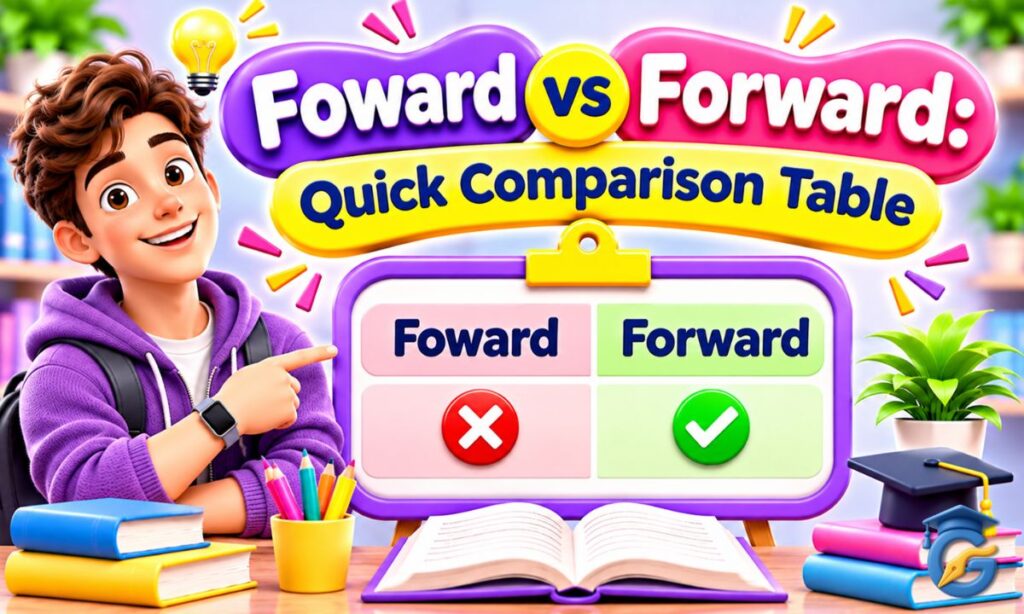
Sometimes a quick visual is the fastest way to remember a rule. The table below puts the foward vs forward comparison side by side so you can scan it in seconds. It shows spelling status, dictionary listing, parts of speech, and a sample sentence for each version. Save it, screenshot it, or bookmark this page for the next time you feel unsure.
| Feature | Foward | Forward |
|---|---|---|
| Correct spelling | No | Yes |
| Found in dictionaries | No | Yes |
| Parts of speech | None | Verb, adverb, adjective, noun |
| Sample sentence | “Please foward this email.” (wrong) | “Please forward this email.” (correct) |
As you can see, the foward vs forward comparison is not close. One version is a real word with many uses, and the other is only a slip of the keyboard. Whenever you doubt yourself, remember that adding the missing r fixes the problem immediately. This tiny change protects your credibility in any professional or academic setting, from a quick text to a formal report.
How to Use “Forward” Correctly in a Sentence
Using forward correctly is easy once you see it in action. As an adverb: “She stepped forward to accept the award.” As a verb: “Please forward the report to your manager.” As an adjective: “The team made forward progress this week.” None of these sentences would work with foward, so the foward vs forward rule is simple to apply.
Tip: Read your sentence out loud and ask yourself, am I describing direction, progress, or sending something on? If the answer is yes, the word you want is forward with an r. This habit takes five seconds and clears up the foward vs forward issue before you hit send. Pair it with a final spell check for extra safety.
How to Spell Forward Correctly Every Time
A simple memory trick can lock in the spelling. Break the word into two parts: for and ward. Think of the phrase “for the win” and picture yourself moving forward toward the goal. If you can see the word for at the start, you will never leave out the r. This method works well for students, non-native speakers, and busy professionals who want to avoid the foward vs forward slip.
Tip: Turn on autocorrect or add a custom text shortcut on your phone and computer so that foward changes to forward automatically. Many people use this trick for their most common typos. Combined with the word-parts method, it makes the foward vs forward mistake nearly impossible, and your writing looks cleaner without any extra effort on your part.
Forward as a Verb, Adverb, Adjective, and Noun
Forward is a flexible word that fits four parts of speech. As an adverb, it tells direction: “Please step forward.” As an adjective, it describes a noun: “The forward section of the plane was empty.” As a verb, it means to send on or advance: “I will forward your message.” As a noun, it names a player: “The forward scored twice.”
Because the word does so many jobs, it shows up constantly in writing. That is another reason the foward vs forward mix-up matters, since a single typo can appear in emails, sports reports, and business updates alike. Learn the four roles once, and you will recognize the correct spelling in any sentence, no matter how the word is used or where it sits.
Common Expressions and Phrases That Use the Word Forward

English is full of idioms built around this word. People say look forward to something they are excited about, move forward after a setback, and put your best foot forward to make a good impression. Business writers use going forward to mean from now on. Each phrase keeps the same spelling in every context, so the foward vs forward rule never changes.
Other common phrases include forward-thinking, fast forward, forward slash, and pay it forward. You will see these in news stories, tech guides, and everyday chats. Writing them with foward would break the phrase and confuse readers. Every one of these expressions relies on the correct foward vs forward answer, which is always the full spelling with an r.
Forward vs Forwards: Understanding the Difference
Many writers also wonder about forward and forwards. In American English, forward is the usual adverb: “Move forward.” In British English, forwards is also common: “Move forwards.” Both are acceptable, but US style guides prefer the shorter form. For the noun meaning a player, the plural is always forwards, as in “The team has three forwards.”
Notice how this question differs from the foward vs forward issue. Forward and forwards are both real words, so the choice is about style and region. Foward, on the other hand, is never correct. If you write for an American audience, choose forward for adverbs and adjectives, and save forwards for the plural of the noun or for a deliberate British tone.
Real-Life Examples of “Forward” in Action
Here is how the word shows up in daily life. At work, you might write, “Can you forward me the invoice?” At school, a teacher might say, “Let’s move forward to chapter five.” At a soccer game, a commentator says, “The forward breaks through the defense.” In every setting, the spelling stays the same, and the foward vs forward rule holds.
At home, a parent may tell a child, “Take one step forward and jump.” In personal growth, a coach might say, “Keep looking forward.” These real examples show that the correct spelling matters in ordinary conversation as well as formal writing. The right spelling keeps your message clear and professional, and it saves you from awkward corrections later.
Common Mistakes People Make With “Foward”
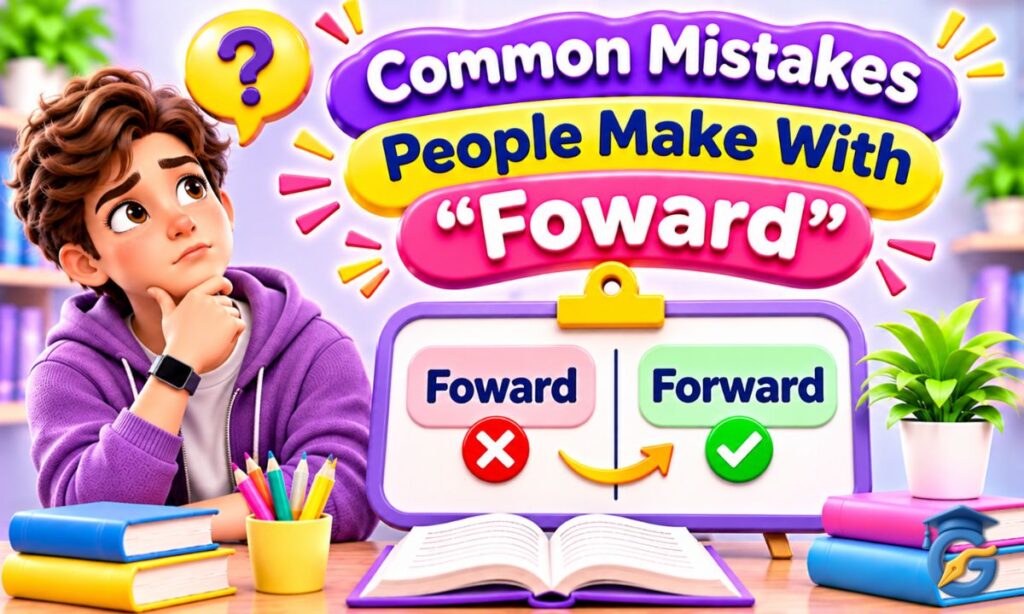
The most common mistake is dropping the first r while typing quickly, which produces foward. Another is mixing forward with foreward, a spelling that sounds right but does not exist. Some writers also confuse it with foreword, a real word with a different meaning. Each of these errors fuels the foward vs forward confusion and can slip past a quick read.
A fourth mistake is using forwards where forward belongs, such as “forwards motion” in American writing. Even careful writers fall into the foward vs forward trap when they rush. The fix is simple: slow down on words that repeat often, read your text backward one sentence at a time, and run a spell check before you publish or send anything.
Why Do People Keep Typing “Foward”?
There are a few reasons behind the typo. The word has two r sounds in different positions, and the first one is soft in many accents, so the brain skips it. Fast typing makes this worse, because fingers often move faster than attention. That is why the foward vs forward slip is so common, even among confident and experienced writers.
Phone keyboards add another problem. Small keys and predictive text can swap or drop letters, and many people ignore the small red underline. Non-native speakers may also write the word the way they hear it. None of this means a person is a poor writer. It simply explains why foward keeps appearing in search bars, drafts, and chat messages.
Which One Should You Use, Forward or Foward?
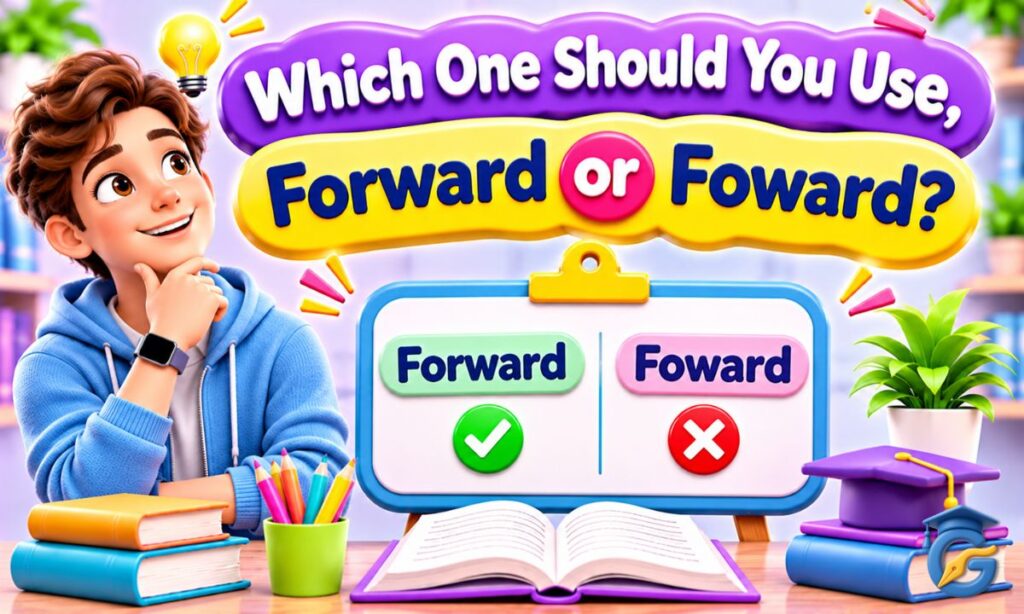
The answer is always forward. There is no situation, formal or casual, where foward is acceptable. Whether you write a school essay, a text message, a social post, or a legal letter, the spelling with the r is correct. The foward vs forward decision is one of the easiest in English, because only one option actually exists.
If you want a simple rule, remember this: no r, no word. Use forward whenever you mean direction, progress, sending something on, or a sports position. Use forwards only when you need the plural noun or a British-style adverb. With this rule in mind, the foward vs forward question will not slow you down again, whatever you are writing.
Related Words People Often Mix Up
Several words look close to forward and cause trouble. Foreword is the short introduction at the start of a book, so you read a foreword before chapter one. Forth means onward or out, as in “back and forth.” Forewarn means to warn in advance. These are all real words, and each has its own job, unlike the foward vs forward typo.
Another tricky word is froward, an old term meaning stubborn or hard to deal with, now quite rare. People also confuse toward and towards, which follow a pattern similar to forward and forwards. Keeping these words straight supports your understanding of the foward vs forward topic, because it trains your eye to notice small spelling differences.
Frequently Asked Questions
Is “foward” a common spelling mistake?
Yes, it is a very common typo, mostly because fast typing drops the first r. It is still always wrong.
What is the plural form of forward?
The plural noun is forwards, as in “two forwards on the court.”
Can “forward” be used as a verb?
Yes. To forward means to send something on, as in “Please forward this email to me.”
Is “forward” one word or two?
It is one word. Never split it into “for ward,” and use a hyphen only in compounds like forward-thinking.
What is the opposite of forward?
Backward is the most common opposite, and back or rear can work in some contexts.
Conclusion
The foward vs forward debate has a clear winner. Forward is the only correct spelling, with a long history, many meanings, and four parts of speech. Foward is just a typo, and it carries no meaning at all. Remember the for plus ward trick, and you will spell the word right every time you write it.
Good writing grows from small habits, and checking commonly mistyped words is one of the best. Use the tips from this guide, turn on autocorrect for foward, and keep exploring grammar lessons to sharpen your skills. With practice, the foward vs forward question will feel easy, and your writing will look polished, confident, and professional.
