

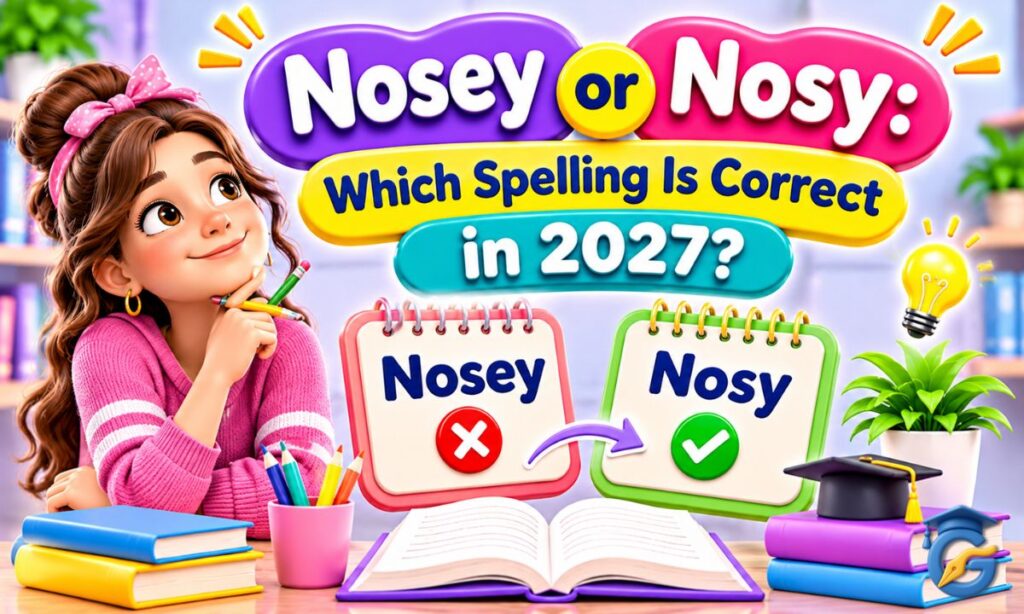
You know the type. A coworker keeps peeking at your screen, or a neighbor asks one question too many about your weekend plans. Then you sit down to describe that person in writing and freeze. Is it nosey or nosy? One tiny letter can make you doubt a word you have heard and said your whole life.
Here is the good news. This guide settles the nosey or nosy debate with a clear answer, real examples, and simple memory tricks you can use right away. You will also learn where the word came from, when the other spelling still shows up, and how to avoid costly mistakes in emails, résumés, and social posts.
Why “Nosey or Nosy” Confuses So Many People

The confusion makes sense because English is not always logical. Many words that end in an “ee” sound use y, such as happy, bossy, and sunny. Yet other words use ey, like Disney, Jersey, and money. When writers face nosey or nosy, both choices look believable, so the brain simply picks one and hopes for the best.
Hearing the word out loud does not help either. Both spellings sound exactly the same, so there is no pronunciation clue to lean on. Add autocorrect, casual texting, and old habits, and you get a spelling that changes from page to page. That is why searches for nosey or nosy stay popular year after year.
Quick Answer: Nosey vs Nosy
The short answer is simple. Nosy is the standard spelling, and it is the one you should use in almost every situation. Major dictionaries list it first, and most editors, teachers, and style guides expect it. If you remember only one thing from the nosey or nosy question, remember that nosy is the safe choice.
Nosey is not a total invention. Some dictionaries record it as a less common variant, and you will still see it in older books, in British writing, and in the phrase Nosey Parker. Still, a variant is not the same as a preferred form. When in doubt about nosey or nosy, pick nosy and move on.
What Does “Nosy” Mean? (Clear Definition + Tone)
At its core, nosy is an adjective that describes someone who shows too much interest in other people’s private business. A nosy person asks personal questions, listens in on conversations, or looks at things that are not theirs. The word carries a mild judgment, which is why many people double check nosey or nosy before using it.
Context also shapes how the word lands. Said with a smile, nosy can sound playful. Said with a frown, it can sound like a real complaint. Either way, the meaning stays the same no matter which spelling you choose, so the nosey or nosy decision only changes how polished your sentence looks to readers.
Simple Definition
In plain terms, nosy means overly curious about things that are not your concern. Dictionaries often explain it with words like prying, snooping, and intrusive. The word always points to curiosity that crosses a line. Healthy curiosity asks how the world works, while nosy curiosity reads a stranger’s text messages over their shoulder.
Tone Matters More Than You Think
Nosy can sound teasing, annoyed, or sharply critical, and the effect depends on your delivery. Calling a friend nosy during a joke feels light and harmless. Calling a manager nosy in an email can feel rude. Before you settle the nosey or nosy spelling, think about whether the word fits the mood you want.
Examples in Real Sentences
Here are a few correct examples to study. “My nosy neighbor watched us carry boxes into the house.” “She felt nosy asking about his salary.” “The nosiest kid in class always reads the notes on the teacher’s desk.” Each sentence uses the standard spelling, and any of them would pass an editor’s check in the nosey or nosy debate.
Where Did “Nosy” Come From? (The Real Origin)
The word grows from a very simple idea. Take the noun nose, add the ending y, and you get an adjective, in the same way rose becomes rosy and smoke becomes smoky. At first, a nosy person could simply have a big nose. Over time, the meaning shifted toward someone who pokes their nose into other people’s business.
That image sits at the heart of the word. People have long used the nose as a symbol for sniffing out secrets, much like a dog following a scent trail. Understanding this history helps with the nosey or nosy question, because the standard spelling follows the same pattern as many other adjectives built from everyday nouns.
How the Word Evolved
Language changes slowly, and nosy followed that path. It began as a plain description of a feature, picked up its prying meaning, and then became a common everyday label for snoopy people. Along the way, printers and writers tried both forms, which explains why nosey or nosy both appear in older texts. Dictionaries eventually favored one.
So Why Not “Nosey”?
English usually drops the silent e when adding the ending y to a base word. Nose becomes nosy, just as noise becomes noisy and bone becomes bony. Keeping the e would break that common pattern. That is the main reason editors choose nosy in the nosey or nosy contest, since the shorter form follows the rule.
Nosy vs Nosey: The Real Difference (Side-by-Side)

Many people expect a big difference between the two forms, but there is no difference in meaning at all. Both describe a prying person, and both sound exactly alike. What changes is how acceptable each spelling looks to readers. So the real nosey or nosy difference is about convention and trust, not about definition.
To make things easy, the table below compares nosey or nosy side by side. Use it as a fast reference whenever you feel unsure. The comparison covers meaning, standard status, typical use, and the risk of looking careless in formal writing, so you can decide in seconds which spelling fits your situation.
| Feature | Nosy | Nosey |
|---|---|---|
| Meaning | Overly curious about private matters | Exactly the same |
| Standard status | Main spelling in major dictionaries | Listed as a variant, if at all |
| Best use | School, work, news, and social media | Dialogue, informal fiction, and the phrase Nosey Parker |
| Comparative forms | Nosier, nosiest | Usually still written nosier, nosiest |
| Risk level | Very low | May look like a typo |
Key Insight
The key insight is that this is a spelling issue, not a meaning issue. Nobody will misunderstand you if you write nosey, but some readers may judge the mistake. Since nosy costs you nothing and avoids that risk, it wins every time. Treat nosey or nosy as a question that already has a clear default answer.
What Dictionaries and Experts Actually Say
Dictionaries are the best referees for spelling disputes, and they mostly agree here. Well-known references such as Merriam-Webster, Oxford, Cambridge, and Collins list nosy first, and some of them mention nosey as an alternate form. When you check the nosey or nosy question in a dictionary, the lead spelling is nosy.
Editors and teachers follow the same guidance. Style guides used in newsrooms and publishing houses usually default to the dictionary’s first spelling, so nosy is what you will see in print. Grammar experts also point out that a variant spelling does not make a word wrong, but it does make it less standard.
Consensus Across Trusted Sources
The consensus is easy to summarize. Trusted sources list nosy first, mention nosey as a variant, and recommend the standard form for general writing. No major source treats nosey as the better choice. If you need a quick rule for nosey or nosy, follow the first spelling in the dictionary and you will be correct.
What That Means for You
For everyday writers, this leads to one simple habit. Use nosy in emails, essays, reports, captions, and blog posts. If you are writing for a school or a business, the standard form protects your credibility. You can skip the research next time, because the answer to nosey or nosy is not going to change.
Why Using the Wrong Spelling Can Hurt Your Writing
Spelling errors rarely cause disasters, but they do chip away at trust. Readers often notice small mistakes before they notice good ideas. When you write nosey instead of nosy, some people will assume you made a typo, even if the variant exists. That small doubt is the real cost of the nosey or nosy mix-up.
The effect grows with the audience. A friend will not care about one extra letter in a text message, but a hiring manager, professor, or editor might. Because you rarely know exactly who will read your words in the future, it is smarter to follow the common rule from the start and avoid the worry.
Here’s What Happens When You Use “Nosey”
When you use nosey, a few things can happen. Spell checkers may underline it in red, readers may think you were careless, and your page may look less polished next to competing articles. The word will still be understood, but it creates friction. In the nosey or nosy choice, that friction buys you nothing.
In Professional Contexts
In professional writing, details matter. A résumé, cover letter, report, or client email should look clean and careful, and one misspelled word can pull attention away from your strengths. If you ever describe a colleague’s behavior, use nosy, or choose a gentler word like curious. This is one more place where nosey or nosy is not worth the risk.
Discover more: Success or Sucess: Correct Spelling, Meaning & Usage Guide
When You Can Use “Nosey” (Yes, There Are Exceptions)

Even in the nosey or nosy debate, there are exceptions, and nosy is still the standard form. The best known is the British phrase Nosey Parker, which is often written with ey, although you may also see it as Nosy Parker. Writers also use nosey on purpose in fiction to show casual speech or a character’s unusual style.
These exceptions are narrow. They depend on a clear reason, such as matching an established phrase, copying a brand name, or capturing a character’s voice on the page. If you cannot name the reason, you should not use the variant. Think of nosey as a special tool for special moments, not a daily choice.
Situations Where It Works
Nosey works best in informal settings where style matters more than standard spelling. Examples include dialogue in a novel, a text between friends, a quoted line from a speaker, or the name of a business that chose the ey on purpose. In those cases, readers will see it as a creative choice, not a mistake in the nosey or nosy puzzle.
Example
Here is a quick example of both uses. In a story, you might write: “Don’t be so nosey, Tom,” she said with a laugh. The spelling reflects a casual, playful voice, and readers will not mind. In a school essay or workplace report, however, the same idea should read: Don’t be so nosy, Tom.
But Be Careful
Be careful with this freedom. Once you use nosey in a story, stay consistent so readers do not think it was an accident, and avoid mixing both spellings in the same document. If your teacher, editor, or client has a style guide, follow it before your own taste in the nosey or nosy choice.
How to Form Nosy, Nosier, and Nosiest Correctly
To compare things, change the y to i and add the ending er or est. That gives you nosy, nosier, and nosiest. For example, “My aunt is nosy, my cousin is nosier, and my grandmother is the nosiest of all.” Words like noisy, rosy, and cozy follow the same pattern, so the rule is easy to remember.
Avoid forms like noseyer or noseyest, because they look unnatural and are rarely used. Also remember that nosily is the adverb, as in “She nosily read the letter on the table.” Once you choose nosy in the nosey or nosy decision, the rest of the word family follows along without any trouble.
Is “Nosy” an Insult or Just a Way to Describe Someone?
Nosy leans toward criticism, but it is not a harsh insult. It is closer to a mild complaint, like saying someone is pushy or meddling. Friends may use it jokingly, while a stranger may take real offense. The nosey or nosy spelling does not change this tone, but your relationship with the reader certainly does.
If you want to stay polite, you can soften the sentence. Try “She is very interested in everyone’s news” instead of “She is nosy.” You can also say a question felt a bit personal. Those choices keep your message clear without sounding like an attack on someone’s character, and they work well in professional settings.
Nosy vs Curious vs Inquisitive: Understanding the Differences
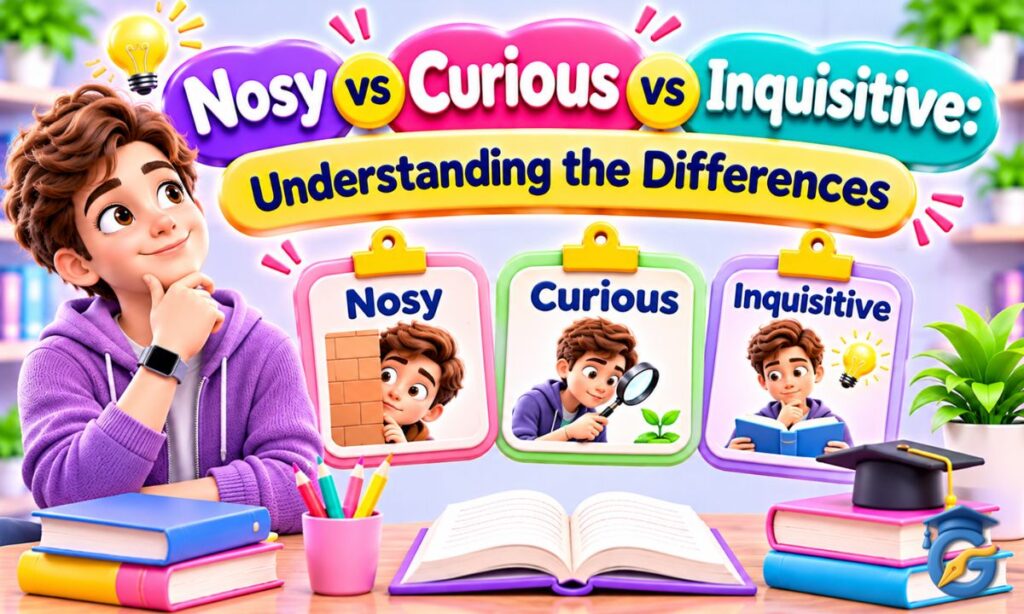
These words overlap, but they are not twins. Curious is mostly positive and describes a desire to learn. Inquisitive is also positive and usually points to asking many thoughtful questions. Nosy is negative because it suggests prying into private matters. Knowing the difference helps you choose better words than just guessing nosey or nosy.
A simple example shows the gap. A curious child asks how airplanes stay in the sky. An inquisitive student asks for more details about the science lesson. A nosy classmate asks what grade you got and then reads your paper. All three share the urge to ask, but they show very different respect for boundaries.
Common Expressions and Phrases Using the Word “Nosy”
English has many fun phrases built around the nose. People say nosy neighbor, nosy parker, and nosy question. Others say “stick your nose in,” “poke your nose around,” and “keep your nose out of it.” These phrases make the word easy to remember, and they often show up in searches about nosey or nosy.
The origin of Nosey Parker is debated, so avoid claiming one exact source. What matters is that the expression means a person who pries, and it often keeps the ey spelling in British usage. In everyday American writing, nosy parker with a y is perfectly fine, and the nosey or nosy question rarely trips anyone up here.
Why Do Some Writers Spell It “Nosey” Instead of “Nosy”?
There are three common reasons. First, people think the word should keep the silent e from nose. Second, they remember the ey in Nosey Parker and apply it to every use. Third, they simply copy what they saw online. These habits explain why the nosey or nosy confusion continues across social media and personal blogs.
Regional habits play a part too. British writing has long shown more flexibility with variants, while American style guides push toward the dictionary’s main form. Informal typing adds another layer, since people rarely stop to check spelling when they text. None of these reasons make nosey wrong in meaning, but they do not make it the best choice.
Common Mistakes People Make (And How to Avoid Them)

Most spelling trouble comes from a few predictable habits. People assume both forms carry equal weight, trust their gut over dictionaries, or forget who is reading. These mistakes feel small, yet they show up everywhere, from classroom essays to company newsletters. Spotting them early makes the nosey or nosy choice much easier.
The good news is that each mistake has a simple fix. The sections below walk through three common errors and end with a quick checklist you can use before sending any message. Read them once, and you will rarely second guess the word again. With a little practice, the right spelling will feel automatic.
Mistake #1: Thinking Both Are Equal
Many writers believe both spellings are equally correct. In truth, nosy is standard and nosey is a variant, and they do not carry the same weight in formal writing. When people treat nosey or nosy as a coin flip, they take a risk that can read as careless. The fix is to default to nosy.
Mistake #2: Trusting Logic Over Usage
English spelling follows usage, not logic. You might think nosey looks right because nose has an e, but dictionaries record what people and publishers actually use. Trying to reason your way through nosey or nosy can lead you astray. When logic and the dictionary disagree, the dictionary wins every time.
Mistake #3: Ignoring Context
Some writers copy a spelling from a fun caption or a novel and then use it in a formal setting. Context matters, because a creative spelling in fiction may not suit a report. Always ask who your audience is before settling the nosey or nosy question. A quick pause now saves you from awkward corrections later.
Quick Fix Checklist
Use this quick checklist before you hit send. First, write nosy unless you have a clear creative reason. Second, make sure comparisons read nosier and nosiest. Third, avoid mixing spellings in one document. Tip: use your editor’s search feature to find “nosey” and replace it in seconds. That small step ends the nosey or nosy worry.
A Simple Memory Trick That Actually Works
Here is a trick you can remember in seconds. Think of this sentence: “A nosy person has a y, because they keep asking why.” The y in nosy matches the y in why, and asking why is exactly what a prying person loves to do. That picture makes nosey or nosy easy to settle for good.
If you prefer another cue, link the word to similar ones you already know. Noisy, rosy, and cozy all end in y, and nosy joins that family. Tip: say the group out loud a few times and the pattern sticks. The next time nosey or nosy appears in your draft, the right choice will feel obvious.
How People Use “Nosy” in Real Life
In daily life, nosy shows up in conversations about family, neighbors, coworkers, and even apps. You might say a smartphone app is nosy because it asks for too many permissions. News headlines also use the word for people who pry into other people’s affairs. This broad use explains why nosey or nosy questions come up so often.
Because the word is so common, spelling it correctly helps you look polished. It appears in talk shows, novels, blog posts, and school lessons. Readers meet nosy far more often than nosey, so the standard form feels natural to them. Matching that expectation keeps your writing smooth, clear, and easy to read from start to finish.
Where You’ll See “Nosy” Most
You will see nosy most in published writing, including newspapers, magazines, books, textbooks, and websites. It also dominates formal communication like emails and reports, plus many casual conversations online. Because editors work hard to keep spelling consistent, the standard form appears again and again. That steady presence makes the nosey or nosy answer easy to trust.
Where “Nosey” Still Appears
Nosey still appears in social media captions, fan fiction, personal blogs, older printed works, and the phrase Nosey Parker. It also shows up in names, such as brands or story characters. These uses tend to be informal and personal. They show that nosey or nosy is a real debate, but not an even one.
Case Study: Social Media vs Professional Writing

To see how this plays out, compare three common scenarios. Each one has a different audience and a different level of formality. Looking at them side by side shows why the standard spelling is the smartest default. The examples below are hypothetical, but they reflect situations writers face every day when dealing with nosey or nosy.
The pattern is clear. The more public and professional the audience, the more important the standard spelling becomes. The more private and playful the setting, the more freedom you have to bend the rules. Understanding this range turns the nosey or nosy choice into a quick decision instead of a long worry.
Scenario 1: Twitter Post
Imagine you post, “My nosy neighbor just asked how much rent I pay.” Followers will understand either spelling, and nobody will complain about a casual slip. Still, using nosy keeps your post clean and avoids replies about spelling. On a public timeline, small choices like nosey or nosy can shape how credible you seem.
Scenario 2: Resume or Cover Letter
In a résumé or cover letter, you will rarely use the word at all. If you do, for example in a customer service story about a nosy client, use the standard spelling. Hiring managers read quickly and notice errors easily. A single wrong letter can cost you more than you expect, so nosy is the only safe pick.
Scenario 3: Fiction Dialogue
In fiction, you can bend spelling rules to capture voice. A character might say, “Don’t be nosey, honey,” and the style fits their warm, casual tone. Just keep your choice consistent across the book. Many editors still prefer the standard nosy in narration, so save nosey for dialogue when the nosey or nosy choice supports character.
Why “Nosy” Won the Language Battle
Language competition is a quiet process. Over decades, writers, editors, and dictionary makers settle on forms that are simple, consistent, and easy to learn. Nosy fits all three. It follows the common rule for adding y to nouns, and it looks tidy on the page. That is why the nosey or nosy contest has a clear winner.
The winner is not decided by one vote. It comes from thousands of small decisions made by publishers and teachers over many years. Once a form becomes standard, schools teach it and software tools support it, which strengthens it further. That cycle explains why nosy now leads by such a wide margin in print and online.
Three Reasons “Nosy” Took Over
Three reasons stand out. First, the spelling follows a familiar pattern with words like noisy and rosy. Second, dictionaries and style guides list it first, which shapes what editors choose. Third, spell checkers and teachers reinforce it daily. Together, these forces settled the nosey or nosy debate in favor of the shorter form.
Deep Dive: How English Handles Spelling Variants
English has many words with two accepted spellings, such as gray and grey, or judgment and judgement. Usually one form is more common in a certain region or context. Dictionaries record both when readers use both, but they typically mark one as the main choice. The nosey or nosy question fits that same pattern.
Variants appear because English borrowed words from many languages and never had a single rule maker. Printing, regional habits, and changing tastes all shaped what we see today. Some variants fade, while others survive for centuries. Knowing this history makes spelling feel less random and more like a story of habits that settled over time.
What’s the Pattern?
The pattern is that variants survive when each form has its own niche. Grey lives mostly in British writing, while gray leads in American writing. Nosey survives in dialogue and the phrase Nosey Parker, while nosy covers general writing. This split explains why nosey or nosy keeps appearing even though one form is clearly more standard.
What You Should Do
Your best move is simple. Choose the form that fits your audience, use it consistently, and double check when in doubt. For American readers, that means nosy. If a teacher, client, or editor requests another style, follow their guide. Following this rule will keep any nosey or nosy worry away for good.
Quick Comparison List: Right vs Risky Choices
Sometimes a short list works better than another explanation. The table below sorts common situations into safe and risky choices. Use it as a cheat sheet when you proofread. If you spot a risky choice, swap in the safe one before you publish or send anything that involves nosey or nosy.
Notice that the safe column never changes. Nosy, nosier, nosiest, and nosily cover nearly every need you will ever have. The risky column only works in rare creative cases. Keep this short list nearby while you edit, and you will rarely have to search for the nosey or nosy answer again.
| Situation | Right choice | Risky choice |
|---|---|---|
| Essay or report | nosy | nosey |
| Email or résumé | nosy | nosey |
| Comparing people | nosier, nosiest | noseyer, noseyest |
| Adverb form | nosily | noseily |
| Fiction dialogue | nosy (always safe) | nosey (only with a clear purpose) |
Frequently Asked Questions
Readers often ask the same few questions after learning the basics. Instead of leaving them scattered, this section answers each one in a line or two. Use it as a quick reference whenever you need a fast answer on nosey or nosy without rereading the whole guide from the top.
The questions below cover tone, grammar, formality, synonyms, and regional preferences. They are also the questions people type into search engines most often. Each answer is short on purpose so you can scan and move on. If you want more detail, return to the matching section above.
Is “Nosy” Considered Rude or Offensive?
Nosy is mildly negative, not a curse word. It can feel rude if aimed directly at someone, so choose your tone with care.
What Is the Comparative and Superlative Form of “Nosy”?
The comparative is nosier and the superlative is nosiest, as in “my nosier cousin” and “the nosiest neighbor.”
Can “Nosey” Be Used in Formal English Writing?
It is best avoided. In the nosey or nosy choice, nosy is the safe formal form.
What Is Another Word for Someone Who Is Nosy?
Prying, snoopy, meddlesome, and intrusive all work well, depending on the tone you want.
Is “Nosy” the Preferred Spelling in American English?
Yes. American dictionaries and style guides list nosy as the main spelling.
How Do You Use “Nosy” Without Sounding Disrespectful?
Use it lightly, add humor, or soften it with phrases like “a bit nosy.” Avoid harsh labels in public.
Conclusion
So, which spelling is correct? Nosy is the winner for American English, formal writing, and everyday use. Nosey is a variant that still appears in dialogue and in the phrase Nosey Parker, but it carries a real risk of looking like a typo. The nosey or nosy debate is about convention, not meaning.
Keep the memory trick close, use nosier and nosiest for comparisons, and save nosey for creative cases only. As we head into 2027, nothing suggests the standard will change. Write nosy with confidence, and the next time nosey or nosy crosses your mind, you will already know the answer.
