

Have you ever stopped in the middle of an email and wondered whether you spelled a common word correctly? You are not alone. The sentence vs sentance question trips up students, professionals, and even confident writers every single day. One tiny vowel can turn a perfectly good word into a spelling error that readers notice right away.
The short answer is simple, and this guide explains it with clear examples. You will learn what the word means in grammar and in law, where it comes from, and why the wrong spelling shows up so often. By the end, the sentence vs sentance mix-up will never slow you down again.
Sentence vs Sentance: The Quick Answer
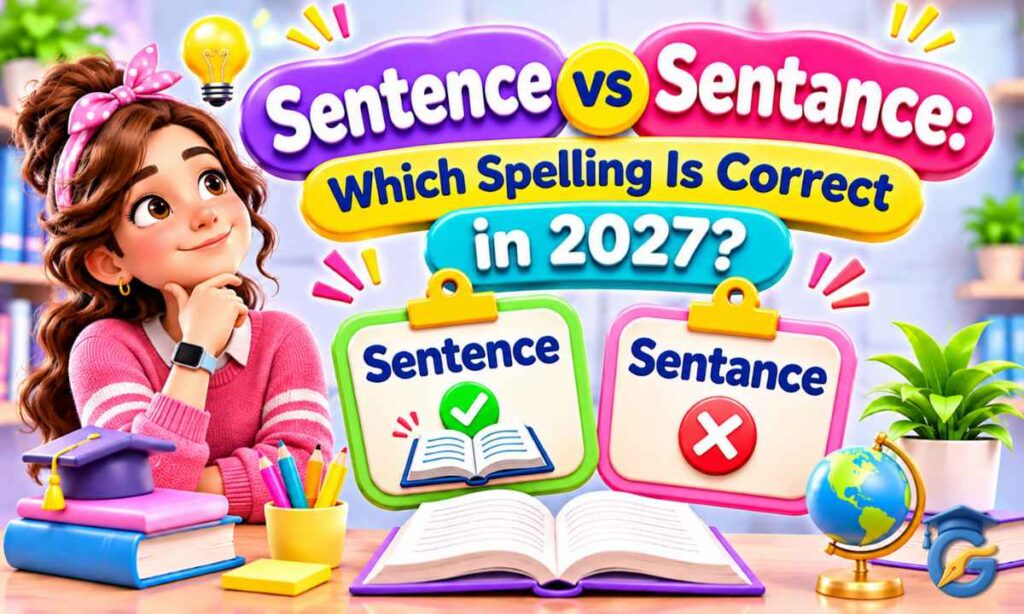
The correct spelling is sentence, written with an E in the middle and an E at the end: s-e-n-t-e-n-c-e. In the sentence vs sentance comparison, only the first version appears in standard dictionaries. The form sentance is a common misspelling, and no major dictionary lists it as an accepted variant.
This answer will not change in 2027 or any year after that. English spelling rules shift slowly, and this word has kept the same form for centuries. If you remember one thing about sentence vs sentance, remember that the correct word has three E’s and no A anywhere inside it.
What Does the Word “Sentence” Mean?
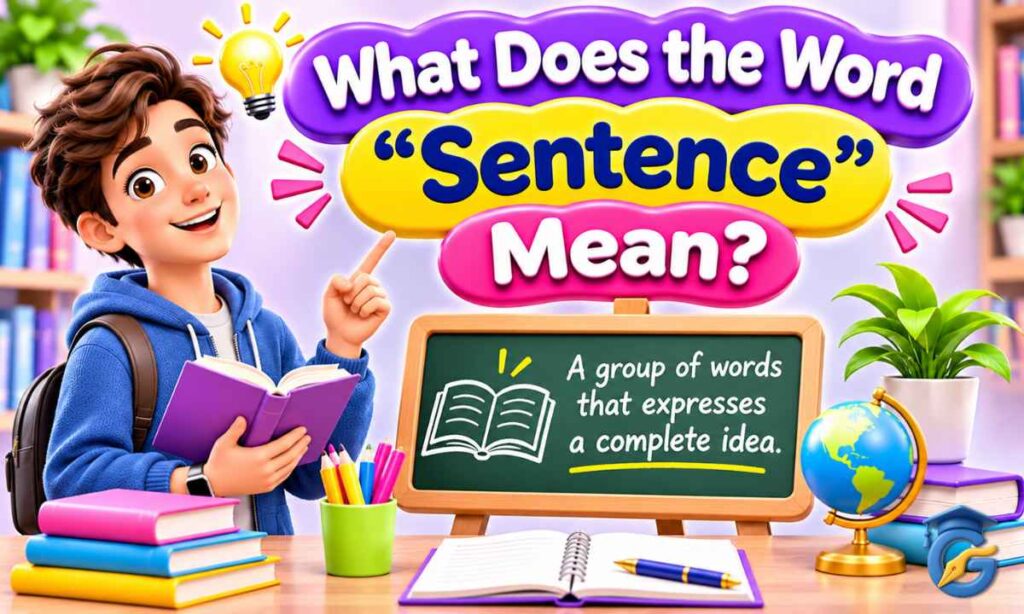
The word sentence carries two main meanings in everyday English. In writing, it means a group of words that expresses a complete thought. In a courtroom, it means the punishment a judge gives to someone found guilty. Both meanings use the same spelling, which keeps things simple for writers.
Knowing the meaning helps you spell the word with more confidence. When you picture a complete thought or a judge’s decision, you also picture the real word on the page. This is why the sentence vs sentance debate has such a clear winner: a made-up spelling has no meaning to attach to.
Sentence Meaning in Grammar
In grammar, a sentence is the basic unit of written and spoken communication. It starts with a capital letter, ends with a period, question mark, or exclamation point, and contains at least a subject and a verb. Teachers rely on this idea when they ask students to write complete thoughts.
Grammar books also describe sentences by purpose. A declarative sentence makes a statement, an interrogative sentence asks a question, an imperative sentence gives a command, and an exclamatory sentence shows strong feeling. Every one of these types uses the correct spelling, so the sentence vs sentance choice never changes by sentence type.
Examples
Here are a few quick examples of each type. The dog barked loudly. is a declarative sentence. Did you finish your homework? is a question. Close the door. is a command, and What a beautiful day! shows excitement. Each one is a complete thought, and each one is always spelled with the letter E, never with an A.
Definition
A simple definition works well for most readers: a sentence is a group of words that has a subject, a verb, and a complete idea. If any of those parts is missing, you may have a fragment instead. Getting the definition right is easier when you also spell the word right, so the sentence vs sentance check matters even in a basic grammar lesson.
Sentence Meaning in Law
In law, a sentence is the punishment a court orders after a person is convicted of a crime. A judge may order prison time, a fine, probation, or community service. News reports use this word constantly, so legal writers and journalists need to spell it correctly every single time they write.
Legal documents have little room for spelling errors because small mistakes can look careless or even change meaning. A court record that said sentance would raise eyebrows quickly. The sentence vs sentance issue is therefore more than a classroom problem, since professionals in law and media depend on accurate spelling.
Examples
Legal examples show the word in action. The judge handed down a sentence of two years. The lawyer asked for a lighter sentence based on good behavior. Reporters also use the verb form: The court will sentence the defendant on Friday. Notice that the spelling stays the same whether the word is a noun or a verb.
The Origins of the Word Sentence
The word sentence comes from the Latin word sententia, which meant opinion, feeling, or judgment. That Latin term grew from sentire, a verb meaning to feel or to think. The word then passed into Old French as sentence before it entered English during the Middle Ages.
This history helps explain the spelling. The ending comes from the Latin -entia, which became -ence in English. Related words such as sentient, consent, and sentiment share the same root and keep the letter E. Looking at the origin makes the sentence vs sentance answer easy to trust.
Why Do People Write “Sentance” Instead of “Sentence”?

Most people who write sentance are not careless. Their brains are following patterns they already know from other words and from the way the word sounds. The sentence vs sentance confusion usually comes from a few common causes, and understanding them is the first step toward fixing the habit for good.
The main causes are unclear pronunciation, the large group of English words ending in -ance, fast typing, and the challenges English learners face. The sections below explain each cause with simple examples. Once you see why the mistake happens, you can spot it before it reaches your final draft.
Grammatical Role of the Word Sentence
The word sentence works as both a noun and a verb. As a noun, it names a group of words or a punishment, as in She wrote a sentence on the board. As a verb, it means to give a punishment, as in The judge will sentence him today. Both roles use the same spelling.
Because the word can change roles, writers meet it in many kinds of text. Its forms also include sentences, sentenced, and sentencing. Every one of those forms keeps the E before the final ending, so the sentence vs sentance rule applies across the entire word family without any exceptions.
English Pronunciation Can Be Misleading
In normal speech, English speakers often soften unstressed vowels into a quick “uh” sound called a schwa. The second syllable in sentence is unstressed, so its vowel sounds almost the same as the A in a word like about. That sound makes the letter A seem logical to the ear and fuels the sentence vs sentance mix-up.
Spelling in English often does not match pronunciation, and this word is a classic case. You cannot rely on your ear alone when you decide between the two spellings. Instead, trust the written form and the memory tricks later in this guide to lock in the correct letters for good.
Many English Words End in “-ance”
English has many common words that end in -ance, such as importance, distance, balance, performance, and assistance. Writers see these endings all the time, so the brain starts to treat -ance as the default. That habit pushes some people toward the sentence vs sentance error when they write quickly.
English also has a big group of words ending in -ence, including presence, silence, evidence, difference, and science. No simple rule separates the two groups, so memorizing is the safest method. For the sentence vs sentance choice, place sentence firmly in the -ence group.
Fast Typing Causes Mistakes
Speed is a major cause of spelling errors. When you type quickly, your fingers move faster than your attention, and you may swap or replace letters without noticing. A rushed typist can slip into sentence vs sentance trouble even when they know the correct spelling perfectly well.
Autocorrect and spell check help, yet they can miss mistakes in rushed messages, especially on small phone screens. Tip: after you finish typing an important message, pause for five seconds and scan it for tricky words. A quick check takes almost no time and protects your credibility with every reader.
English Learners Often Struggle With It
English learners face extra challenges because spelling rules in English have many exceptions. A learner who knows the word from listening may write it the way it sounds, which makes the sentence vs sentance problem even more likely. Many languages spell words closer to their sounds, so English can feel unfair.
Learners can improve quickly with small habits, such as keeping a list of tricky words and reviewing it weekly. Seeing sentence in many real examples builds a strong visual memory. With steady practice, the sentence vs sentance problem fades, and the correct spelling starts to feel natural.
Sentence vs Sentance: Side-by-Side Comparison
A direct comparison makes the difference clear. Sentence is a real English word with a Latin origin, a grammar meaning, and a legal meaning. Sentance has no dictionary entry, no meaning, and no history. The only thing it does is signal a spelling error to the reader.
The table below summarizes the key points of the sentence vs sentance comparison. Use it as a quick reference whenever you feel unsure. You can also save it in your notes for a fast check before you send an email, submit an essay, or publish a post.
| Feature | Sentence | Sentance |
|---|---|---|
| Correct spelling | Yes | No |
| Found in dictionaries | Yes | No |
| Meaning | Complete thought or punishment | None |
| Origin | Latin sententia | None |
| Example | She wrote a clear sentence. | A common typo |
What Do Dictionaries Say About Sentence vs Sentance?
Major dictionaries, including Merriam-Webster, Cambridge, and Oxford, list only sentence as the correct form. They give definitions for the grammar meaning, the legal meaning, and the verb form. None of them offers sentance as a variant, an alternate, or a regional spelling.
That consistency matters because dictionaries record how educated writers actually use words. If a spelling were accepted in modern English, it would appear in at least one reliable source. In the sentence vs sentance question, the dictionary evidence points in one direction only.
How Often Do People Search for “Sentance”?
People search for this misspelling regularly, which shows how common the confusion is. Search engines often suggest the correct spelling when someone types sentance, because so many users make the same slip. Exact search numbers change over time, so check a keyword tool for current data on sentence vs sentance searches.
This steady interest also explains why clear answers are so useful. Students, writers, and teachers look for quick, trustworthy explanations. A good guide helps them fix the error and learn the pattern, which is better than a one-line correction with no reasoning behind it.
How to Spell Sentence Correctly Every Time
The best way to spell sentence correctly is to break it into two syllables: sen and tence. Say each part slowly, then write it out letter by letter. The full spelling is S-E-N-T-E-N-C-E, with an E in the middle and an E at the end.
A few memory tricks make the spelling stick for good. They work because they connect the word to something you already know. Try each trick below and keep the one that feels easiest, since the best sentence vs sentance fix is the one you actually remember.
Memory Trick: Think of the Word “Ten”
Look closely at the middle of the word and you will find the number ten hiding there: sen-TEN-ce. If you remember that ten sits inside the word, you will always write E after the T. This simple picture settles the sentence vs sentance question in about two seconds, with no guessing between A and E.
Memory Trick: Remember the Ending
Remember that the correct word has three E’s and zero A’s. Say it like a tiny chant: three E’s, no A. The ending is -ence, the same as in presence and silence. Write it once on a sticky note and keep it near your desk as a daily reminder of sentence vs sentance.
Memory Trick: Write It in Real Sentences
Practice works best in context. Write three real sentences using the word, such as My teacher read my sentence aloud. or The judge gave a fair sentence. Seeing the correct spelling inside a full thought helps your memory far more than copying one word again and again, and it makes the sentence vs sentance choice automatic.
Singular and Plural Forms of Sentence

The singular form is sentence, and the plural form is sentences. You make the plural by adding an S, with no other change. This regular pattern is easy to remember. Writers who use sentance also tend to write sentances, which repeats the error and doubles the damage.
The plural appears whenever you talk about several complete thoughts or several punishments. For example: Short sentences are easier to read. and The judge gave two sentences. The sentence vs sentance rule stays the same in both forms, so one correct habit covers every case.
Sentence Examples in Everyday Writing
In daily life, you use the word in notes, texts, and emails. Write one sentence about your weekend. and That sentence sounded rude. are common examples. Because everyday writing feels casual, mistakes slip in easily, so a quick glance at sentence vs sentance before you hit send is a smart habit.
Sentence Examples in School
Students use the word more than almost anyone. A teacher might say, Begin each sentence with a capital letter. or Rewrite this sentence in the past tense. Exams, essays, and worksheets all include it, and many teachers treat the sentence vs sentance error as a simple but avoidable slip that costs easy points.
Sentence Examples in Business Writing
Professional writers use the word in reports, proposals, and training materials. A manager might write, Please shorten the second sentence in the summary. Clients judge a company by its writing, so a typo in a basic word can weaken trust. The sentence vs sentance slip is small, yet it is easy to avoid.
Sentence Examples in Law
In legal writing, the word often means punishment. Examples include The sentence was reduced on appeal. and The court delayed the sentence until next month. Lawyers and clerks must use exact language, and even in law, sentence vs sentance is not a debate, because only one spelling is accepted.
Sentence Usage in Formal and Informal Communication
In formal settings such as essays, reports, and legal papers, the word sentence must be spelled correctly because readers expect polished writing. Errors in formal documents can make the whole piece seem less reliable. Formal writers also tend to proofread more carefully, which helps them catch problems like sentance early.
In informal settings such as texts and social posts, people relax, and typos feel less serious. Still, the sentence vs sentance mistake can look sloppy even in a casual chat with a boss or a teacher. Using the right spelling everywhere builds a consistent habit that never lets you down.
Examples of the Incorrect Spelling “Sentance”
Seeing the error in context helps you spot it later. Incorrect examples include Please read this sentance twice., Each sentance needs a period., and The judge gave a harsh sentance. All three look fine at a quick glance, yet each one contains the same mistake in the same place.
Now compare the corrected versions: Please read this sentence twice., Each sentence needs a period., and The judge gave a harsh sentence. The fix is always one letter. Train your eye on this sentence vs sentance contrast, and you will notice the wrong version almost instantly.
Discover more: Success or Sucess: Correct Spelling, Meaning & Usage Guide
Why Correct Spelling Matters
Correct spelling shows care, and readers notice care. A single typo rarely ruins a message, but repeated errors can change how people see you. Employers, teachers, and customers often connect clean writing with attention to detail, so a basic word like sentence deserves your full focus.
Spelling also affects online credibility. A blog post, product page, or resume with sentance in it can lose trust within seconds. Solving the sentence vs sentance problem is a small task, yet it protects your reputation in school, at work, and anywhere your words are read.
Common Situations Where People Misspell Sentence

Most mistakes happen in predictable moments. People misspell the word when they write in a hurry, type on a phone, or draft a long document late at night. Tired minds rely on habit and sound, and both can lead straight to sentance when no one is watching.
Mistakes also appear when writers focus on big ideas and ignore small details, such as during brainstorming or note taking. The sentence vs sentance error is easy to fix later if you plan a short proofreading pass. Waiting until the final draft is the safest time to look for it.
Common Words People Misspell Like Sentence
Many other words cause similar trouble. Common examples include separate (often written as seperate), definitely (often written as definately), occurrence, necessary, and restaurant. Like sentence, these words contain vowels that sound unclear in speech, which makes the correct letter hard to guess.
Spotting the pattern helps you improve across the board. Words with soft, unstressed vowels need extra attention. The same memory tricks that solve sentence vs sentance also work for these words, such as finding a smaller word inside, like the rat in separate.
Sentence vs Sentance in British and American English
Some English words differ between regions, such as color and colour, or center and centre. The word sentence is not one of them. British, American, Canadian, and Australian writers all spell it the same way, with the same E in the final syllable and the same meaning.
That means there is no regional excuse for sentance. In the sentence vs sentance question, geography changes nothing, and spell checkers in every English setting will flag the wrong version. You can write confidently for any global audience as long as you use the standard form.
Sentence Structure Basics
Understanding structure helps writers use sentences well. Every complete sentence needs a subject, which tells who or what the sentence is about, and a predicate, which tells what the subject does or is. Together, they express a full thought that readers can understand without extra help.
English has four basic structures: simple, compound, complex, and compound-complex. Each one combines clauses in a different way. Knowing these types lets you vary your writing and keep readers engaged. It also gives you another reason to treat the sentence vs sentance spelling as a settled matter.
Simple Sentence
A simple sentence has one independent clause and expresses one complete idea. Examples include The baby smiled. and Maria reads every night. Simple sentences are short and clear, which makes them perfect for headlines, instructions, and strong opening lines that grab attention right away.
Compound-Complex Sentence
A compound-complex sentence has at least two independent clauses and at least one dependent clause. For example: Although it rained, we played soccer, and we had fun. This type shows the most detail, but it can become hard to read if the clauses pile up too fast.
Use this structure sparingly, and mix it with shorter sentences for balance. Good writers know when to build a rich sentence and when to keep things light. Whatever the structure, the spelling stays the same, so the sentence vs sentance rule never changes from one type to the next.
Compound Sentence
A compound sentence joins two independent clauses with a comma and a conjunction such as and, but, or so, or with a semicolon. An example is I wanted to walk, but it started raining. Each clause could stand alone, and the connector shows how the two ideas relate to each other.
Complex Sentence
A complex sentence has one independent clause and at least one dependent clause. An example is When the bell rang, the students left. The dependent clause cannot stand alone, so it needs the main clause to finish the thought. Words like because, when, and although often start dependent clauses.
Case Study: Why One Letter Matters
Imagine a student applying for a scholarship. The essay is thoughtful, but the opening line says, This sentance changed my life. A reviewer reading hundreds of essays may notice the error immediately. The writer never meant to look careless, yet the typo can distract from a strong story.
Now imagine the same essay with the correct word. The reader moves smoothly into the story with nothing to distract them. This simple example shows why the sentence vs sentance choice deserves attention. One small letter can decide whether a reader focuses on your message or on your mistake.
Tips to Avoid Spelling Mistakes

Good spelling comes from steady habits, not from natural talent. You do not need to memorize a dictionary. You only need a few simple routines that catch errors before anyone else sees them. The tips below work for students, professionals, and anyone who wants cleaner writing every day.
Choose one or two tips and use them for a full week. Small habits grow fast when you repeat them. Soon, spotting issues like sentence vs sentance will feel automatic, and your writing will look sharper without extra effort. Start with the easiest tip and build from there.
Read Slowly
Reading too fast makes your brain fill in the letters it expects, so errors hide in plain sight. Slow down and read each word on its own. Reading aloud works especially well because it forces your eyes and ears to check every word, and slow reading is the best defense against sentence vs sentance slips.
Use Spell Check
Spell check catches most errors, including sentance, within a second. Turn it on in your email, word processor, and phone. Remember that it is not perfect, since it can miss correctly spelled but wrong words, so treat it as a helper and not as a replacement for your own careful eyes.
Proofread Important Documents
For resumes, essays, reports, and legal papers, always proofread at least once. Wait a few hours if you can, because fresh eyes see more. You can also ask a friend or coworker to read it. A second reader will often catch a sentence vs sentance error that you have stopped noticing.
Read More Books
Reading builds a strong visual memory for correct spelling. Every time you see sentence in a book, article, or story, your brain stores the right pattern. Choose topics you enjoy so the habit feels fun. Over time, your instincts improve, and the sentence vs sentance question answers itself.
Practice Difficult Words
Keep a short list of words that give you trouble, and review it every few days. Write each word three times, then use it in a sentence. Add sentence to the list, especially if sentence vs sentance still confuses you. Targeted practice solves problems much faster than simply hoping you will remember.
Fun Facts About the Word Sentence
Here are a few fun facts. The word sentence has two syllables and eight letters, and it contains three E’s. It shares a root with sentient and sentiment, which both connect to feeling and thinking. A sentence can also be a single word, such as Stop! or Run!
The word also works as both a noun and a verb, which gives it more range than many English words. Its meaning stretches from classroom lessons to courtroom decisions. With such a rich story behind it, the sentence vs sentance debate feels one-sided, since only one version has a history.
Frequently Asked Questions
Can “sentance” ever be correct?
No. Sentance is always a misspelling, and no major dictionary accepts it as a variant.
What is the plural of sentence?
The plural is sentences. Just add an S to the singular form.
Is sentence a noun or a verb?
It is both. As a noun, it means a complete thought or a punishment, and as a verb, it means to give a punishment.
How many syllables are in sentence?
Two syllables: sen and tence.
What are synonyms for sentence?
For the grammar meaning, try statement or utterance. For the legal meaning, try punishment, penalty, or judgment.
Conclusion
The answer to the sentence vs sentance question is clear: sentence is the only correct spelling. It comes from the Latin sententia, it appears in every major dictionary, and it follows the same form in every English-speaking country. The version with an A is simply a common typo.
Use the memory tricks from this guide, such as finding ten inside the word and remembering three E’s with no A. Add a quick proofreading habit, and the sentence vs sentance mistake will disappear from your writing. Now you can write every line with confidence and a clean, professional finish.
