


Few spelling choices trip up writers as often as the adress or address question. You type an email, fill out a shipping form, or send a quick text, and your fingers hesitate for a split second. Is it one D or two? One S or two? That tiny pause happens to students, busy professionals, and native speakers alike.
The good news is that the answer is simple, and it never changes. Only one spelling is correct in English, and this guide explains it in plain language. You will learn the meaning, the origin, the plural, the verb forms, and easy memory tricks that settle the adress or address debate for good, whether you write in 2027 or any year after.
Adress or Address – Quick Answer
Quick answer: the correct spelling is address, written with a double D and a double S. The form “adress” is wrong in American English, British English, and every other English variety. If you feel unsure in the moment, choose the longer spelling, because it is the only one that dictionaries recognize in the adress or address choice.
A fast memory aid helps here. Think of the word as ad + dress, and the doubled letters appear at once. This short rule settles the adress or address problem in seconds, and it works for every form of the word, including addresses, addressed, and addressing. You will find more helpful tricks later in this guide.
Meaning of “Address”
As a noun, address means the place where a person lives or an organization operates, such as a home or an office. It also means the details used to send mail or messages, like a postal address, an email address, or a web address. Another noun sense is a formal speech. As a verb, it means to speak to someone or to deal with a problem.
Examples
Here are a few clear sentences. “Please write your home address at the top of the form.” “The mayor will address the crowd at noon.” “We need to address the budget problem soon.” “Her email address has changed.” Each sentence uses the correct spelling, and none of them could use “adress” without creating an error. Read them aloud once to lock in the pattern from the adress or address debate.
The Origin of Address
The word address has a long history. It entered English from Old French, where a form like adrecier meant to direct or to set straight. That French word grew out of Latin roots built on ad, meaning toward, and directus, meaning straight. Over time, English settled on the double D spelling we use today, which ends the adress or address debate.
Meanings also grew over the centuries. Early on, the word was about directing words or actions toward a target. Later, it came to describe speeches given to a group, then the direction written on a letter, and finally the location of a home or business. Knowing this story makes the adress or address choice easier to remember, because every sense still carries the idea of aiming toward something.
Why “Adress” Is Incorrect in English
The form “adress” is incorrect because English spelling follows the word’s roots and the dictionary standard, and neither supports a single D. The word is built from the prefix ad and the base dress, and the doubled letters stay in place. No major style guide, including AP, Chicago, or Oxford, accepts the short form. In the adress or address comparison, only one option appears in print.
Why does the mistake spread so easily? Part of the reason is other languages. French and German both spell the word adresse, with a single D, so learners often carry that habit into English. Fast typing and autocorrect lapses also play a role. Still, repeating a wrong form does not make it right, so treat every adress or address slip as a simple typo to fix.
British English vs American English Spelling (Address or Adress)

Many English words change between regions, such as color and colour or center and centre. The word address is not one of them. American, British, Canadian, Australian, and Indian English all use the same spelling. The adress or address question therefore has no regional twist, and you never need to switch spellings based on where your readers live or travel.
This consistency is a gift for global writers. You can write one version of a webpage, shipping form, or email signature and use it everywhere. Only the format of an address changes, such as the order of the street, city, and postal code. The spelling of the word itself stays steady, which keeps the adress or address decision easy in any market.
Comparison Table
This table shows how the word behaves across major English varieties. As you can see, every row gives the same result, because no region accepts the shortened form. Teachers, editors, and content managers can copy it into a style guide for their teams and use it as a quick reference whenever the adress or address question comes up in daily editing work.
| Region | Correct Spelling | Is “Adress” Accepted? | Example |
|---|---|---|---|
| United States | Address | No | Please update your mailing address. |
| United Kingdom | Address | No | What is your home address? |
| Canada | Address | No | Enter your delivery address. |
| Australia | Address | No | Send it to the office address. |
| India | Address | No | Share your email address. |
Does the Spelling Change by Region?
No, the spelling does not change by region. A reader in New York, London, Toronto, or Sydney will find “address” in the dictionary and expect the same in your writing. What does vary is formatting, such as “Apt. 4” in the United States versus “Flat 4” in the United Kingdom. Remember this difference when you wrestle with adress or address, because only the layout changes, never the letters.
What Is the Plural of Address? Correct Spelling and Examples

The plural of address is addresses, formed by adding ES. Because the word already ends in SS, adding only an S would make it hard to say, so English adds ES instead. This is the same rule used in boss and bosses or class and classes. The incorrect plurals “adresses” and “addreses” are common slips in any adress or address discussion.
Here are some examples. “We stored three hundred email addresses in the database.” “The company has two office addresses in Texas.” “Please verify all shipping addresses before checkout.” Notice that each plural keeps the double D and the double S. If you can spell the singular correctly, you only need to add ES. That keeps the adress or address rule consistent across both forms.
Common Phrases and Expressions Using the Word Address
The word shows up in many everyday expressions. You might address the issue, give a keynote address, or share a forwarding address when you move. Tech users know the IP address and the web address, while event planners rely on a public address system. Each phrase uses the same spelling, so the adress or address mix-up never changes the correct form.
Other expressions are more formal. A form of address tells you how to speak to someone, such as “Dr.” or “Ms.” The idiom address the elephant in the room means to talk about an obvious problem that people avoid. People also say change of address when they relocate. Learning these phrases makes the adress or address rule feel natural, since you meet the word so often.
Which Spelling Should You Use?
Choosing the right spelling is easy because you only have one option. The word address is correct in every setting, from a casual note to a legal contract. The real skill is applying it with confidence and checking your work. Think of the adress or address choice as a settled rule, not a style preference that changes with your audience.
Context still matters when you add other details around the word. Business, academic, and online writing each have habits that surround it. The next sections show how to use the correct spelling in each setting and where mistakes tend to hide. Keep these notes handy the next time an adress or address doubt crosses your mind during a busy workday.
For Business Writing
In business writing, accuracy builds trust. A wrong spelling on an invoice, contract, or website footer can make a company look careless. Always write address in full, with clear labels such as “billing address” or “mailing address.” Proofread email signatures and letterheads too, since one mistake repeats thousands of times. A clean adress or address check protects your brand image and prevents shipping errors.
For Academic Writing
Academic writing demands precise spelling, and graders notice small errors. Use address as a verb in essays when you discuss how a study handles a question, as in “This paper addresses the gap in current research.” Check the word in your reference list and headings as well. A quick scan for adress or address mistakes before you submit can protect your grade.
For Online Forms
Online forms often ask for a “street address,” “email address,” or “billing address.” Labels must be spelled correctly, because a typo can confuse users and lower trust. Developers should also test field names and error messages. For users, one wrong letter in an email address can send a message to the wrong person, so the adress or address habit matters.
For Global Audiences
For global audiences, stick with address and keep your sentences simple. Non-native readers often rely on translation tools, and a misspelled word can produce odd results. Pair the spelling with clear labels, like “postal address” or “delivery address.” This approach keeps your message easy to follow and removes any adress or address confusion for international readers.
Addressed, Addresses, or Addressing: Correct Word Forms
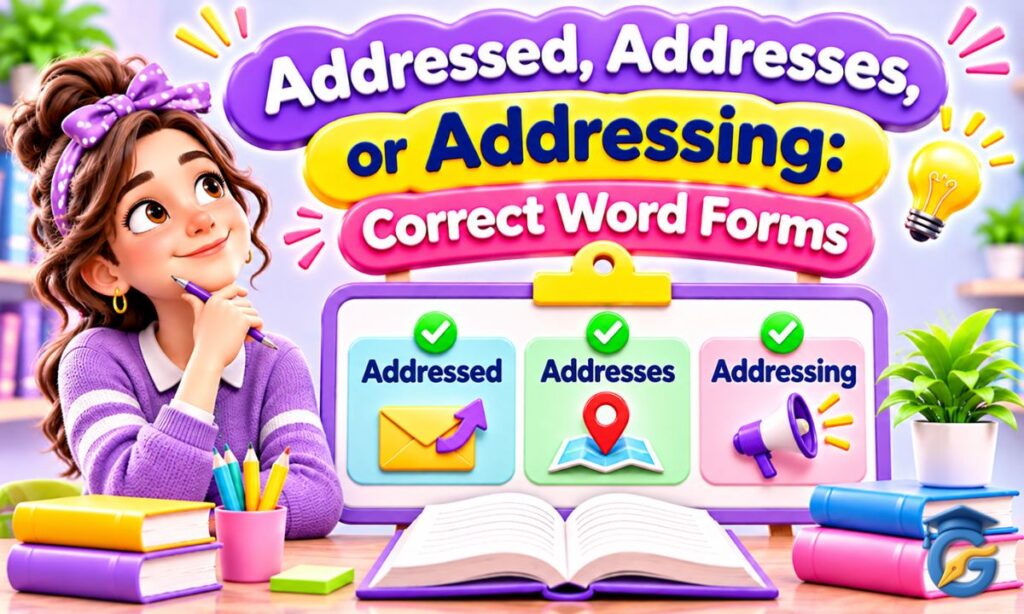
The word has four main forms. Address is the base form and the present tense. Addresses works as the plural noun and as the third person singular verb. Addressed is the past tense and the past participle, and addressing is the present participle. All forms keep the double D and the double S, which keeps the adress or address rule steady across them.
Examples help. “She addresses every email within an hour.” “He addressed the letter to his aunt.” “They are addressing the safety concerns this week.” Notice how the base word never loses a letter. The wrong versions, such as “adressed” and “adressing,” are common typos that follow the same adress or address pattern of dropping a letter from the middle of the word.
Common Mistakes with Adress or Address
Most errors with this word come from four sources. Writers drop a D, drop an S, mix up noun and verb forms, or struggle with capital letters. Each error is easy to fix once you spot it. Reviewing your work for these patterns turns the adress or address worry into a simple checklist you can run in a few seconds.
A short proofreading routine helps a lot. Search your document for “adress” using find and replace, then scan for “addres” and “adresses” as well. Tip: set up an autocorrect entry that changes “adress” to “address” in your word processor. This small habit saves time and keeps your adress or address accuracy high in long reports, newsletters, and website pages.
Dropping One “D”
The most common error is writing “adress” with a single D. It happens because the first syllable sounds short, so the second D seems silent. Remember that the prefix ad stays attached, and then dress follows. For example, “adress” should always become “address.” Fixing this one slip removes most of the adress or address errors found in everyday writing.
Dropping One “S”
A less common error is dropping one S and writing “addres.” This often happens during fast typing, especially at the end of a sentence. The word ends in a double S, just like dress, mess, and press. Check the last two letters whenever you review a draft. This small step keeps your adress or address accuracy strong in every message you send.
Mixing Verb and Noun Forms Incorrectly
Some writers use the wrong form for the job, such as writing “I will addressed the problem” or “my addresses is new.” Remember that the base form follows “will,” and a singular noun needs a singular verb. Say “I will address the problem” and “my address is new.” Matching the form to the sentence keeps your adress or address habit sharp even in tricky grammar.
Capitalization Confusion
Capitalization confuses many writers. Write address in lowercase in normal sentences, such as “Send it to my address.” Capitalize it only at the start of a sentence or in a proper title, like the Gettysburg Address or the State of the Union Address. Capital letters never change the spelling, so the adress or address rule stays exactly the same.
Address in Everyday Examples
Real examples show how the correct spelling appears in daily writing. From inbox messages to news headlines, the word is everywhere. Seeing it in context builds visual memory, which often works better than memorizing rules. Read each of the next examples closely, and notice how the adress or address problem fades when you see the correct word again and again.
You do not need special skills to get this right. A few steady habits help in every setting, including checking forms, reading messages aloud, and trusting your spell checker. The next sections look at emails, news, business messages, social posts, and formal documents. They all follow the same adress or address rule, and each one gives you a fresh model to copy.
In Emails
Emails use the word constantly. A typical line might read, “Please confirm your shipping address by Friday.” Another could be, “I sent the file to the wrong email address.” Because emails move quickly, typos are common. Reread the subject line and the first sentence before sending, and check the adress or address spelling in any signature block.
In News Articles
News articles use address as both a noun and a verb. A headline might say, “Governor to address the state on Monday,” while a report notes, “The suspect’s last known address was in Ohio.” Editors treat the spelling carefully because errors damage credibility. Reading the news regularly can reinforce the correct adress or address form without extra effort.
In Business Communication
Business messages often mention locations and responsibilities. Examples include, “Please update our billing address in your records,” and “The team will address your complaint today.” Both sentences show the noun and the verb side by side. Clear, correct spelling helps customers trust your company, so make the adress or address check part of every review.
Discover more: Nosey or Nosy: Which Spelling Is Correct in 2027?
On Social Media
Social media moves fast, yet spelling still matters. A post that reads, “Leave your email address to enter the giveaway,” looks more reliable than one with a typo. Short posts leave less room for error, so proofread twice before you hit send. Even in casual captions, the right adress or address form shows care and keeps your message professional.
In Formal Writing
Formal writing includes letters, reports, applications, and legal documents. In these, a spelling error can cause real delays, such as a rejected form or a lost package. Write the full address with every line, and double check the postal code. The correct adress or address spelling is a small detail, but it signals professionalism and attention to detail.
Adress or Address – Google Trends & Usage Data

Search data tells an interesting story. People regularly type both versions into Google, which shows how often the adress or address question appears. The correct word typically draws far more searches overall, because it is a daily word tied to shipping, email, and maps. The misspelling appears much less often. You can explore the comparison yourself on Google Trends.
Usage data also suggests that most misspellings are accidental typos, not honest confusion. Search engines often correct the query automatically and show results for the right word. That is helpful, but it should not replace good spelling habits. Treat the adress or address trend as proof that this mistake is common, harmless to fix, and easy to avoid with a little care.
Search Popularity
The word address tends to stay popular all year, and interest likely rises when people move, ship gifts, or fill out forms. Related searches often include “email address,” “IP address,” and “address lookup.” These patterns show real-world demand. Anyone writing about the topic should use the correct form so search engines match their content to the adress or address intent.
Common Search Mistakes
People often search for “adress,” “addres,” “adres,” and “adress meaning.” These variations show the same pattern of dropped letters. Search engines usually suggest the correct spelling right away. If you ever see “Did you mean: address,” accept it. Matching the right form to your content also solves the adress or address problem for readers who reach your page through a typo.
Address vs Addressee: Meaning and Spelling Differences

Address and addressee are related but different. An address is a location or a speech, or the act of speaking to someone. An addressee is the person or group that a message, letter, or package is written to. The suffix EE marks the receiver of an action, as in employee and payee. Settle the adress or address question first, and the longer word follows easily.
Here is a sentence that uses both. “The addressee signed for the package at the address listed on the label.” A common error is writing “adressee” or “addresee,” and both drop a letter. Remember that addressee is simply address plus EE, so the spelling follows from the base word. That keeps the adress or address rule useful for related vocabulary too.
Comparison Table: Adress vs Address
A side by side view is the fastest way to lock in the answer. The table below puts the incorrect and correct forms next to each other, with notes on use. It is short enough to memorize and clear enough to share with a team. It captures the whole adress or address story in one quick glance.
Use it as a reference during editing. Print it, save it as a note, or add it to a style sheet. When you meet the two spellings again, check the table, and the adress or address question will be settled in a moment. Over time, you will not need the table at all.
| Feature | Adress | Address |
|---|---|---|
| Correct in English | No | Yes |
| Number of D’s | One | Two |
| Number of S’s | Two | Two |
| Found in dictionaries | No | Yes |
| Plural form | Not applicable | Addresses |
| Past tense | Not applicable | Addressed |
| Example | “Send it to my adress.” (wrong) | “Send it to my address.” (correct) |
Similar Misspelled English Words
The word address is not the only one that causes spelling trouble. Many English words contain doubled letters that writers forget. Common examples include accommodate, occurrence, embarrass, committee, and recommend. Each one hides a double consonant, much like the adress or address issue. Studying them as a group builds a stronger sense for double letter patterns.
Other tricky words include necessary, millennium, possession, success, and assassin. Some have a double C, a double S, or a double N, and a few have two sets of doubles. Making a short list of your personal trouble words helps more than memorizing a long one. Add address to that list if the adress or address issue still catches you.
How to Remember the Correct Spelling of Address
The easiest trick is to split the word into ad and dress. Picture adding a dress to your closet, and the double D and double S appear in the right order. You can also tell yourself, “Address wears a full dress,” which means no letters are missing. This image makes the adress or address choice almost automatic.
Tip: write the word out three times by hand, then type it three times. This builds both muscle memory and visual memory. Another helpful habit is reading your final draft aloud, one line at a time, and pointing to each address you see. Do this for a week, and the adress or address worry will fade. Pairing it with the ad + dress trick makes it stick.
Frequently Asked Questions
Is “Address” a Compound Word or a Single Word?
It is a single word, written as address with no space or hyphen. It is not a compound.
How Many D’s and S’s Are in the Word “Address”?
Address has two D’s and two S’s, spelled a-d-d-r-e-s-s.
What Is the Correct Past Tense of Address?
The past tense is addressed, with two D’s and two S’s. The past participle is the same.
Is “Addressing” Spelled With Double S?
Yes. It is spelled a-d-d-r-e-s-s-i-n-g, with a double D and a double S.
What Are Some Synonyms for the Word “Address”?
As a noun, try residence, location, or speech. As a verb, try tackle, speak to, or deal with.
How Can I Stop Making Spelling Mistakes With “Address”?
Use the ad + dress trick and add an autocorrect entry that fixes “adress” automatically.
Conclusion
The final answer is clear: address is correct, and “adress” is a misspelling. The word has two D’s, two S’s, and a long history that runs back through Old French. It works as both a noun and a verb, and it keeps the same spelling in every English variety. Settling the adress or address question now saves time and avoids awkward errors.
Next time you feel unsure, remember the ad + dress trick and run a quick check on plural and verb forms. Keep an eye on related words like addressee and addressing. With a little practice, the adress or address problem will no longer slow you down. Write with confidence, and let correct spelling support your message.
