


Few spelling mistakes look as harmless as typing “bodys” instead of “bodies.” One small letter swap, and a careful reader notices right away. The Bodies vs Bodys question shows up in school essays, work emails, and social media posts every day. This guide gives you the clear answer, the grammar rule behind it, and plenty of real examples.
Here is the short answer. Bodies is the only correct plural of body in standard English, while bodys is a spelling error. Once you understand why, the rule becomes easy to remember and apply to many other words. By the end of this article, the Bodies vs Bodys debate will feel settled, and you will write the plural with confidence.
What Is The Correct Plural Of The Body?
The correct plural of body is bodies. When you mean more than one body, you spell it b-o-d-i-e-s every time. For example, you can say, “The museum displays ancient bodies preserved in peat.” In the Bodies vs Bodys comparison, only one spelling survives, and it is bodies. The other version does not appear as a plural in standard dictionaries.
This answer holds true in American English, British English, and every other major variety. There is no regional split here, so you do not need to worry about your audience. If your spell checker underlines bodys in red, it is helping you. Accept the fix, and your sentence will read smoothly and look professional.
Why Do People Get Confused Between Bodies And Bodys?

Most English plurals just add an s, so writers naturally assume body should become bodys. Words like dog, car, and book all follow that easy pattern. The brain notices the habit and applies it again without checking. That is the main reason the Bodies vs Bodys mix-up happens so often, even among confident writers and fast typists.
Another cause is speed. When you type quickly, your fingers follow the common s ending before your mind catches the exception. The spoken sound of bodies also gives no clue about its spelling. Because bodies vs bodys sounds almost the same out loud, only the written rule can settle the question, and that rule is simple.
The Grammar Rule Behind Bodies
The rule is short. If a noun ends in a consonant plus y, change the y to i and add es. Body ends in d plus y, so it becomes bodies. This is the whole grammar behind Bodies vs Bodys, and it works for thousands of nouns. Learn the pattern once, and you can skip guessing for good.
Notice the key phrase, consonant plus y. The letter before the y matters a lot. In body, the letter before y is d, which is a consonant, so the change happens. Compare that with boy, where the letter before y is o, a vowel. That small check is the fastest way to settle Bodies vs Bodys in any draft.
Click To Read another Topic
If you enjoyed this breakdown, you may want to explore other spelling puzzles that trip up writers. Pairs like “lets vs let’s,” “its vs it’s,” and “alright vs all right” create the same kind of doubt. Each one has a clear rule behind it, and learning them together builds strong writing habits that last across every document you write.
A good next step is to pick one confusing word each week and study its rule, just as you did with Bodies vs Bodys today. Short, regular practice works better than long cram sessions. Keep a small notebook of your own errors, and review it often. Soon your spelling instincts will grow sharper without much extra effort.
Quick Comparison Table
Sometimes a side-by-side view makes the answer stick faster than any long explanation. The table below sums up the Bodies vs Bodys question in one glance. It shows each form, its status, and a sample sentence so you can see the difference in action. Save it as a quick reference for later.
| Form | Correct? | Example |
|---|---|---|
| Bodies | Yes, correct plural | Three bodies of water lie near the town. |
| Bodys | No, spelling error | Three bodys of water lie near the town. |
| Body’s | Yes, singular possessive | The body’s temperature rose slightly. |
| Bodies’ | Yes, plural possessive | The bodies’ systems adapt to cold. |
The pattern is easy to spot. Only bodies works as a plural, and the apostrophe forms handle ownership. Whenever you feel unsure about the Bodies vs Bodys choice, glance at this table and confirm the form. Over time you will not need it, because the correct spelling will start to feel natural every time you write.
Is Bodys Ever Correct In Any Situation?
In standard grammar, bodys is never correct as a plural. There is no special context, genre, or style guide that accepts it for the common noun. Formal essays, news articles, and academic papers all use bodies. So if you are asking whether Bodies vs Bodys has an exception in regular writing, the answer is a firm no.
There is one narrow case. A proper noun, such as a surname, a brand, or a username, may be spelled Bodys because the owner chose it. In that case, you copy the name exactly as given. This is a naming choice, not a plural. For the everyday noun, the Bodies vs Bodys rule stays exactly the same.
Where Does This Spelling Rule Come From?

The word body comes from Old English bodig, which meant the trunk or torso of a person. Over the centuries, spelling shifted as English borrowed habits from French and Latin. Writers of the Middle English era often swapped a final y for i before an ending, which helped shape the pattern behind Bodies vs Bodys that we follow today.
Spelling rules like this one became fixed once printing spread and dictionaries appeared. Early dictionary makers wanted consistent forms, so they recorded bodies as the standard plural. Today, the pattern is so firm that bodys looks wrong to almost every native reader. Knowing this history makes the Bodies vs Bodys rule feel less random and more logical.
How Is Bodies Used In Everyday English?
You will meet bodies in news stories, textbooks, and daily conversation. A reporter might write, “Rescue teams recovered several bodies after the flood.” A teacher might say, “Our bodies need water to work well.” In both cases, the word shows up as a plain plural, which is why mastering Bodies vs Bodys pays off so quickly.
The word also appears in set phrases. People say “governing bodies,” “bodies of water,” and “heavenly bodies” without thinking twice. Each phrase uses the same spelling every time. When you notice these patterns while reading, you reinforce the correct form, and the Bodies vs Bodys confusion fades because your eyes slowly learn what looks right.
Discover more: Nosey or Nosy: Which Spelling Is Correct in 2027?
Different Meanings of the Word “Bodies” in English
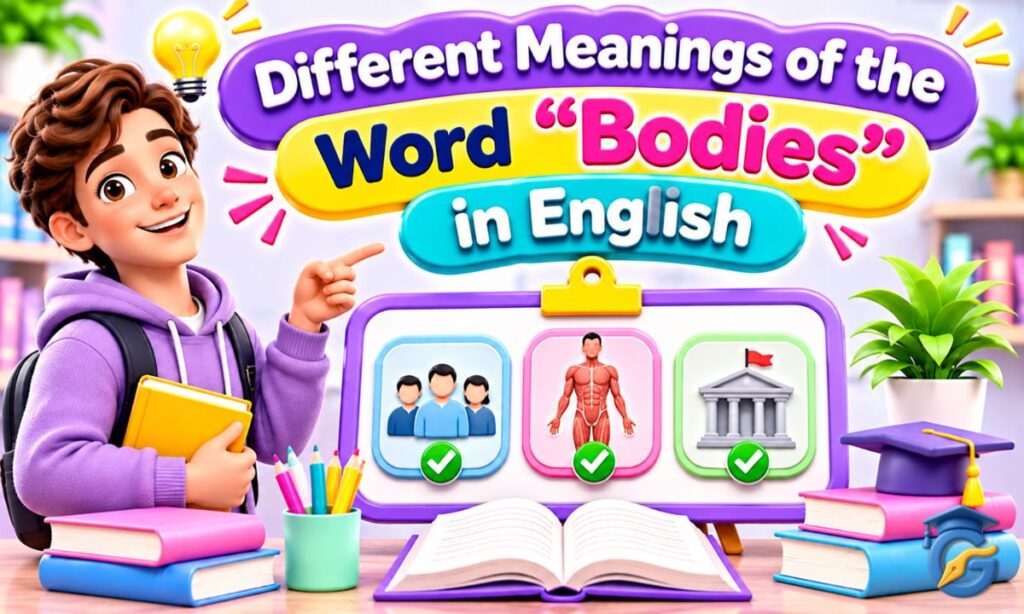
The word bodies carries several meanings beyond the human form. It can mean physical bodies, such as people or animals. It can mean organized groups, such as school boards or regulatory agencies. It can also point to large amounts of something, like bodies of water or bodies of evidence. In the Bodies vs Bodys debate, meaning never changes the spelling.
The word also describes objects in science and engineering. Astronomers speak of celestial bodies, such as planets and moons. Car makers talk about vehicle bodies, meaning the outer frame of a car. Writers sometimes use “bodies of work” for a creator’s complete output. Every sense uses bodies, so remembering one spelling covers all of them.
Singular, Plural, and Possessive Forms of Body Explained
Let’s separate the forms clearly. The singular is body, as in “The body needs rest.” The plural is bodies, as in “Bodies need rest.” Those two forms are the heart of the Bodies vs Bodys lesson. Adding an apostrophe changes the job of the word, so it helps to know exactly what each version does.
The singular possessive is body’s, as in “The body’s defenses are strong.” The plural possessive is bodies’, with the apostrophe after the s, as in “The bodies’ cells repair themselves.” Many writers mix these up, so decide whether you mean one or many first. A simple test is to rephrase with “of the,” such as “defenses of the body,” before you choose the form.
Bodies in Different Contexts: Human, Animal, and Organizational Uses
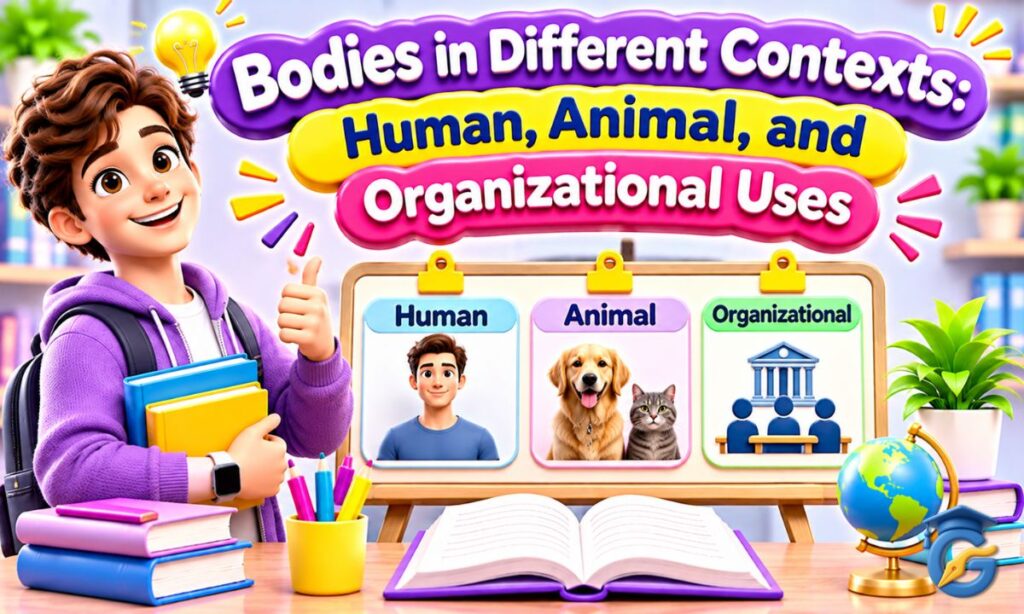
Human and animal contexts are the most common. Doctors write about “human bodies,” and biologists study “animal bodies” in their research. Both uses require bodies, never bodys. Even in short captions or quick notes, the Bodies vs Bodys choice must land on bodies. Good writers keep this consistent because it signals care and builds trust with readers.
Organizational uses follow the same rule. News writers refer to “public bodies,” “governing bodies,” and “legislative bodies” when they mean official groups. A sentence such as “Several regulatory bodies reviewed the plan” is entirely standard. In every context, whether human, animal, or organizational, the Bodies vs Bodys answer does not change, and bodies stays the correct spelling.
More Examples of Bodies Used in Real-Life Sentences
Real sentences make the rule easier to remember. Consider these: “The two bodies collided in space.” “Ancient bodies were found in the bog.” “Athletes train their bodies for years.” Each sentence uses bodies correctly. Reading examples aloud helps your brain link the spelling with the sound, which settles Bodies vs Bodys doubts quickly.
Here are a few more. “Several governing bodies approved the law.” “Lakes and rivers are bodies of water.” “Washing your hands keeps germs from entering our bodies.” Notice that none of these sentences could use bodys. Tip: Write three sentences of your own with the word bodies, and your memory will lock in the Bodies vs Bodys rule.
Similar Words That Change Y to IES in Their Plural Forms
Many everyday nouns follow the same y to ies pattern as body. City becomes cities, baby becomes babies, story becomes stories, and party becomes parties. Country, family, lady, and copy work the same way. If you can spell these plurals, you already know the logic behind Bodies vs Bodys and can apply it with ease.
The pattern does not apply when a vowel comes before the y. Boy becomes boys, day becomes days, key becomes keys, and toy becomes toys. This contrast is useful because it shows the rule is not random. It depends entirely on the letter before the y, which is the whole point of Bodies vs Bodys.
Common Mistakes People Make With This Word
The biggest mistake is simply adding s to make bodys. Another common error is writing “bodie,” which is not a word. Some writers also place an apostrophe where it does not belong, such as “bodie’s” or “body’s” for a plain plural. These errors often come from rushing, so slow down while editing to catch every Bodies vs Bodys slip.
A second group of mistakes involves possessives. Writers type “the bodies health” when they mean “the bodies’ health.” They also write “the body’s” when they are talking about many people. Read your sentence, count the owners, and then pick the right form. A final proofread focused on Bodies vs Bodys can save you from embarrassing errors in published work.
Bodies Vs Body’s Vs Bodys: What Is The Difference?
These three look alike but do very different jobs. Bodies is the plural noun. Body’s is the singular possessive, showing that one body owns something. Bodys is not a valid form at all. Keeping this clear helps you win the Bodies vs Bodys question and also avoids apostrophe mistakes in the same sentence.
A quick test works well. If you mean more than one, use bodies. If you mean something that belongs to one body, use body’s. If you mean something that belongs to many bodies, use bodies’. Bodys never appears in this test, which tells you everything about the Bodies vs Bodys choice. Simply leave it out of your writing.
Which One Should You Use: Bodies Or Bodys?
Use bodies every time you need the plural of body. This is the safe, correct, and professional choice for essays, emails, reports, and posts. There is no situation in regular writing where bodys is the better pick, so you can stop second-guessing. The Bodies vs Bodys decision gets easy once you commit to one simple rule.
Make it a habit. Before you publish, search your draft for bodys and replace each one with bodies. Most word processors can do this with a find tool in seconds. Tip: Reading your text aloud also helps you spot odd spellings. With these small steps, the Bodies vs Bodys error will disappear from your writing for good.
Other Words That Follow The Same Pattern
Dozens of nouns follow the exact pattern of body. Examples include hobby (hobbies), memory (memories), library (libraries), enemy (enemies), and company (companies). Each ends in a consonant plus y, and each changes to ies in the plural. Studying them together reinforces the logic behind Bodies vs Bodys and helps you spell new words correctly on the first try.
The same idea works for verbs in the third person. Carry becomes carries, study becomes studies, and try becomes tries. Once you see the pattern in both nouns and verbs, spelling feels far less like memorizing and far more like using a tool. That is the real lesson hidden inside the Bodies vs Bodys question.
Why Getting This Right Actually Matters
Spelling shapes how readers judge you. A single error such as bodys can make a strong article look careless, especially in business writing, school work, or job applications. Readers may not say anything, but they notice. Getting Bodies vs Bodys right shows attention to detail and helps you build trust with every person who reads your work.
It also matters for search and clarity. People who search for the correct spelling find content that uses it, so accurate writing helps your pages get found and your message land. Small details add up over time. Mastering Bodies vs Bodys is a tiny step, but it supports the bigger goal of clear, credible writing.
Frequently Asked Questions
Is “bodies” always the plural of “body”?
Yes. Bodies is the standard plural of body in every meaning, from human bodies to governing bodies.
Why does body change to bodies instead of bodys?
Because body ends in a consonant plus y, English changes the y to i and adds es.
Can “bodies” refer to more than one organization?
Yes. Phrases like “public bodies” and “governing bodies” refer to several official groups or organizations.
What is the singular form of bodies?
The singular form is body. Use it when you mean just one person, object, group, or mass.
How do you pronounce bodies correctly?
Say it as BOD-eez, with stress on the first syllable and a long e sound at the end.
Conclusion
The Bodies vs Bodys debate has a clear winner. Bodies is the correct plural, because nouns ending in a consonant plus y change the y to i and add es. Bodys is a common typo, not an accepted form, and only a proper name might use it on purpose. Remember this, and your writing will stay accurate.
Keep the rule simple: check the letter before the y, switch to ies if it is a consonant, and use apostrophes only to show ownership. Practice with a few sentences, and the pattern will stick. The next time the Bodies vs Bodys question appears in your draft, you will know the answer instantly and move on with confidence.
