


Have you ever stopped mid-sentence and wondered whether to type connector or connecter? You are not alone. Both spellings look right at a glance, and spell checkers do not always flag the wrong one. This small mix-up shows up in emails, school essays, product pages, and technical manuals every single day.
Here is the short version. Connector is the standard spelling in American English, and it is the one you should use almost every time. In this guide, you will learn why connecter is rare, how the two words compare, and simple rules that make the choice easy.
Connecter vs Connector – Quick Answer
The quick answer to connector or connecter is simple. Connector is correct in standard English. It is a noun that names a person or thing that joins two or more items together. A USB cable end, a plug, and even the word “however” in a sentence can all be called a connector.
Connecter is not the preferred spelling. Some dictionaries list it as a rare variant, and French uses a similar word as a verb. In everyday English, though, writing connecter looks like a typo to most readers. So when in doubt, choose connector and move on with confidence.
Connecter vs Connector: What’s the Difference?

At first glance, connecter vs connector looks like a case of two spellings for one word. That is partly true. Both come from the same Latin root, and both point to the idea of joining things. The real difference lies in acceptance. One spelling is widely trusted, and the other is rarely used.
Think of it like choosing between a well-known road and a side path. Both may lead to the same place, but readers expect the main road. When you use connector, your writing looks polished and professional. When you use connecter, readers may pause, doubt you, or assume you made an error.
Core Definitions
A connector is a noun that means something or someone that connects. In grammar, it can mean a word like “and” or “because” that links ideas. In technology, it means a plug, port, or software link. Connecter is a rare variant of the same noun, and it also exists as a French verb meaning “to connect.”
Mini Recap
Here is a quick recap. Connector is the standard noun in American English. Connecter is rare, often seen as an error, and mostly useful only when you discuss French. If you remember one thing from this section, remember this: choose connector for school, work, and everyday writing, and you will almost never go wrong.
Is Connecter vs Connector a Grammar, Vocabulary, or Usage Issue?

The connecter vs connector question is mainly a spelling and usage issue. It is not a deep grammar problem, because both forms would follow the same noun rules if they were equal. It also touches vocabulary, since you need to know which form is the accepted word. Style guides and dictionaries settle the matter in favor of connector.
That means the debate is less about rules and more about convention. English has many pairs like this, where one spelling wins because readers and editors prefer it. Understanding this helps you stop second-guessing yourself. You can treat connector as the default and save your energy for bigger writing decisions.
Are They Interchangeable?
No, they are not truly interchangeable. A reader might understand connecter, but understanding is not the same as accepting. If you swap them in a resume, a report, or a product listing, the page can look careless. Even when the meaning stays clear, the wrong spelling can weaken trust in the rest of your writing.
Formal vs Informal Usage
In formal writing, such as contracts, manuals, and business proposals, connector is the only safe choice. Informal writing, like texts and chats, is more forgiving, and few people will correct you. Still, typing connector costs nothing extra, and it keeps your habits consistent. Good habits in casual messages often carry over into formal documents.
Academic vs Casual Context
In academic writing, teachers and editors expect standard spellings, and connector is the one they know. Casual contexts, such as social posts or quick notes, allow small slips without much penalty. However, students who write about linking words in English class should always use connector. It also matches the terms found in textbooks and style manuals.
Understanding the Word “Connector”
The word connector is a noun built from the verb “connect” plus the ending “or.” It names the thing or person doing the connecting. The same ending appears in words like actor, director, and conductor. Most English words from Latin roots use this pattern, which is one reason connector feels natural.
You can use connector in many fields. Teachers use it for words that link sentences. Engineers use it for plugs and ports. Software teams use it for tools that link apps together. The examples below show how the word behaves in real situations, so you can copy the pattern with confidence.
Workplace Example
Imagine a manager writing, “Our team lead acts as the connector between sales and design.” Here, connector means a person who links two groups and helps them share ideas. This use is common in business writing and performance reviews. It paints the person as helpful, social, and valuable to the whole company.
Academic Example
In an English class, a teacher might say, “Use a connector such as however or therefore to join your ideas.” In this case, connector means a linking word or phrase. Students learn that connectors guide readers from one point to the next. Strong essays often rely on them to feel smooth and logical.
Technology Example
A tech support page might read, “Plug the HDMI cable into the connector on the back of the monitor.” Here, connector means the physical port or plug. Software documentation also uses it for tools, such as a data connector that links a spreadsheet to a database. The meaning always involves joining one thing to another.
Everyday Example
At home, you might say, “This pipe connector is leaking.” Or you might call a friend who introduces people to each other a social connector. Both sentences use the same word in the same way. That flexibility is exactly why connector is so common in daily speech, from the garage to the group chat.
Is “Connecter” Ever Correct?
Sometimes, yes, but only in narrow cases. A few dictionaries record connecter as a rare variant of connector, and you may spot it in older texts or odd product names. French also uses the word as a verb. So the spelling is not invented, but it is far from the everyday standard.
The trouble is that these cases are rare for most English writers. Unless you are quoting a source, writing about French, or matching a brand name, you will not need it. When people ask about connector or connecter in daily writing, the safe and correct answer is still connector.
As a Rare Noun
As a noun, connecter appears now and then as an uncommon alternate form. You might see it in a few older documents or in informal posts. Major style guides, however, prefer connector, and most readers will not recognize the other form. If you must use it, only do so when copying an exact name or quote.
As a Verb Form (French Context)
In French, connecter is a verb that means “to connect.” A French speaker might say, “Je vais connecter mon téléphone,” which means “I will connect my phone.” English learners who speak French sometimes carry this spelling into English by habit. Knowing this source of confusion helps teachers explain the mistake kindly and clearly.
Why It Is Usually Incorrect in English
In English, connecter is usually incorrect because the standard noun ends in “or,” following the Latin pattern seen in words like actor and inspector. Readers learn these endings through repeated exposure, so the wrong ending stands out. Editors and spell checkers may mark it. Using connector keeps your text clean, expected, and professional.
Which Form Should You Use?
The answer to connector or connecter is the same in nearly every setting: use connector. The only real choice is how to use it well. Match the meaning to your audience, whether you mean a linking word, a plug, or a person. When the meaning is clear, the spelling question disappears.
Below, you will see how this works in four common writing settings. Each one has its own habits, but the spelling stays the same. This helps you build one simple rule instead of memorizing many. A single rule is easier to remember when you are writing under pressure.
Technical Writing
In technical writing, precision matters, so connector is the required form. Manuals, spec sheets, and install guides use it for ports, plugs, and software links. For example, “Insert the power connector until it clicks.” Consistent spelling also helps search engines and readers find the right parts quickly, which improves support pages.
Business Writing
Business emails, reports, and proposals should always use connector. A line like “She is a natural connector who brings partners together” sounds strong and professional. A typo in the same sentence can distract readers from your message. Since business writing builds trust, small details like spelling play a bigger role than many people expect.
Academic Writing
Essays, theses, and class handouts should use connector as well. Writers often discuss connectors as linking words, such as moreover or in contrast. Teachers expect the standard spelling, and using it shows care. Tip: keep a short list of connectors near your desk while drafting, so you can vary your transitions.
Everyday English
In daily life, connector works for chats, texts, and social posts. You can say, “I need a new phone connector,” or “He is the connector in our friend group.” Nobody will question it. Even in quick messages, the standard form keeps your writing clear and avoids small distractions for the reader.
Common Mistakes and Decision Rules

Most errors in the connector or connecter debate come from two sources. The first is sound-alike spelling, since both endings sound almost the same when spoken. The second is mixing up word types, such as using the verb where the noun belongs. Spotting these patterns helps you fix them fast.
The good news is that both mistakes are easy to correct. A short checklist and one clear rule can solve nearly every case. Read the next sections slowly, and test the examples against your own sentences. After a few tries, the right choice will start to feel automatic.
Mistake 1: Writing “Connecter” Instead of “Connector”
The most common error is writing connecter when you mean the noun. For example, “Check the cable connecter” is incorrect. The correct sentence is “Check the cable connector.” The ending sounds the same in speech, so the eye must do the work. A quick proofread for the “or” ending catches this slip.
Mistake 2: Confusing the Verb “Connect” with the Noun “Connector”
Another mistake is confusing the verb connect with the noun connector. You connect a device, but you plug it into a connector. Saying “I connector my laptop” is wrong, while “I connect my laptop” is right. Remember that a connector is a thing or person, and connect is the action.
Decision Rule
Here is a simple rule. If you need a noun in English, write connector. If you need a verb, write connect, connects, or connected. Only use connecter when you quote French or copy a fixed name. Tip: read your sentence aloud and ask whether you are naming a thing or describing an action.
Different Types of Connectors and Their Uses in Modern English

Modern English uses connectors in several ways. In grammar, a connector is a word or phrase that links ideas. Coordinating conjunctions like and, but, and or join equal parts. Subordinating words like because and although link a main idea to a supporting one. Each type guides the reader smoothly.
Connectors also appear outside grammar. Transitional phrases such as for example and in addition add structure to essays. In tech, a USB-C connector links devices, and a data connector links software tools. Whether you write about language or gadgets, the spelling stays connector, and the idea of linking stays constant.
Connector as a Noun: Singular, Plural, and Possessive Forms
Connector is a regular, countable noun. The singular form is connector, as in “This connector is loose.” The plural form is connectors, as in “These connectors fit most devices.” Because it follows the usual rule of adding s, you will rarely stumble on it. It works smoothly in both writing and speech.
For possession, add an apostrophe and s to the singular, as in connector’s, like “the connector’s metal pin.” For plural possession, place the apostrophe after the s, as in connectors’, like “the connectors’ shared design.” Keep these forms straight, and your sentences will look clean and correct.
Connector vs Connection vs Connecting: Key Differences
These three words share a root but do different jobs. Connector is a noun for the thing or person that links. Connection is a noun for the link itself or the state of being linked. Connecting is a verb form, or an adjective, that shows an action in progress.
Here is a quick example: “The connector on this cable is damaged, so the connection keeps dropping while I am connecting to Wi-Fi.” Each word plays a clear role. Ask yourself whether you mean the object, the link, or the action, and the right word will follow.
How Dictionaries Define “Connector” and “Connecter”
In the connector or connecter question, major English dictionaries treat connector as the main entry. They define it as a person or thing that connects, and they often add technical meanings for electrical parts and grammar terms. This steady agreement across sources is a strong sign that connector is the standard form for American English readers.
Connecter, by contrast, appears far less often. Some references list it only as a variant, and others skip it. Because dictionary policies change over time, check a current edition when you need proof. For most writers, the dictionary lesson is plain: pick the main entry and use it.
Discover more: Nosey or Nosy: Which Spelling Is Correct in 2027?
Connector in Everyday Examples
Seeing connector in real sentences makes the rule stick. The word fits many types of writing, from short emails to long reports. Each example below shows the same spelling in a different setting. Notice how the meaning shifts slightly while the form stays the same.
As you read, try writing one sentence of your own for each setting. Practice builds muscle memory faster than rules alone. Soon, typing connector will feel as natural as typing any other common word. That is the real goal of this guide.
Emails
In emails, you might write, “Could you send me the right connector for the projector?” You might also write, “Thanks for being such a great connector between our teams.” Both lines sound friendly and professional. A correct spelling in the first lines of an email also helps set a polished tone.
News Articles
News writers use connector in stories about business, travel, and technology. A headline might read, “New Connector Brings Faster Charging to Phones.” Another story might describe a mayor as a community connector. Editors apply style rules strictly, so published news almost always uses connector, not connecter, in cases like these.
Technology Documentation
Technology documents rely on connector for ports, plugs, and software links. For example, “Select the Google Drive connector in the settings menu.” Clear naming helps users follow steps without confusion. Consistent spelling also supports searchability, so people can find help pages that match the words they type into search.
Formal Writing
In formal writing, such as research papers and legal notes, connector keeps the tone serious and exact. A sentence like “The conjunction serves as a connector between two clauses” is common in grammar studies. Formal readers watch for small errors, so choose the standard spelling and proofread once more before sending.
Connector in Modern Technology and AI Tools
In today’s tech world, connector has become a popular label. Software platforms offer connectors that link apps, files, and databases. For example, a spreadsheet tool may use a connector to pull in data from a cloud drive. The word signals a bridge between two systems that would otherwise stay separate.
AI tools use the same idea. A connector can let an assistant reach an email inbox, a calendar, or a document folder with your permission. Product pages, help centers, and developer guides all spell it connector. If you write about these tools, use the standard form to match the industry.
The Origin and History of “Connector
The word connector traces back to the Latin verb connectere, which joins con, meaning “together,” with nectere, meaning “to bind” or “to tie.” English borrowed connect roughly in the 1500s, and the noun form followed with the common “or” ending. The original meaning of binding things together still lives in the modern word.
English often adds “or” to words from Latin roots, as in actor, doctor, and director. That pattern explains why connector looks right to experienced readers. The French verb connecter comes from the same family, which explains why the “er” spelling still appears in some writing. Shared roots can create look-alike words across languages.
Connecter vs Connector – Google Trends & Usage Data
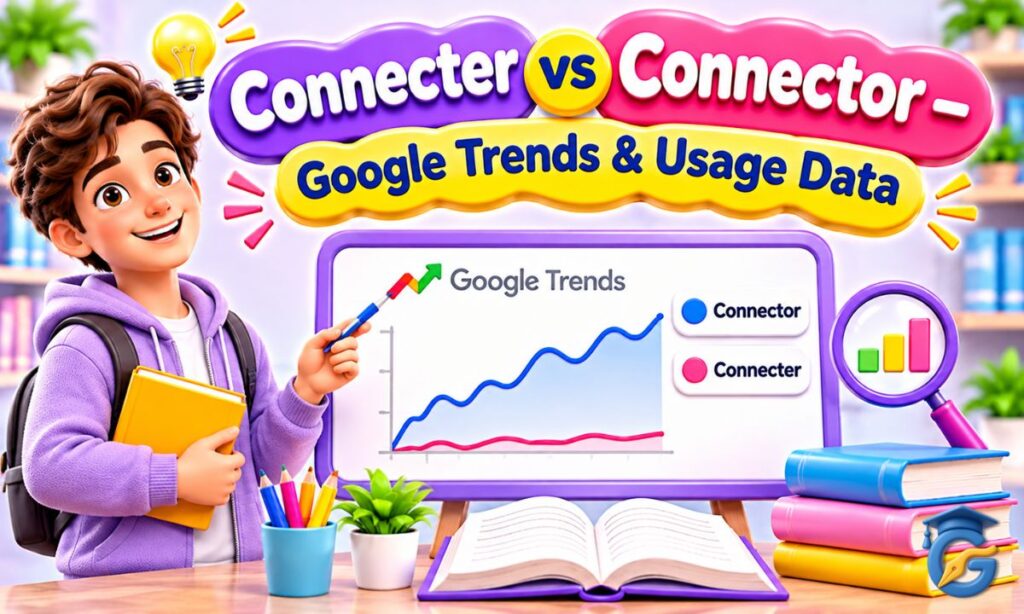
When you compare connecter vs connector in Google Trends, connector typically leads by a very wide margin. This pattern matches what you see in books, news, and product pages. People search for connector far more often because it is the term that names real things, such as cables, ports, and grammar tools.
Exact numbers change over time, so check the live chart yourself for the newest picture. You can also test related phrases, like connector or connecter, to see which spelling people look up. Search interest that favors one form is not a rule, but it supports what dictionaries and editors already recommend.
Comparison Table: Connecter vs Connector
A table can make the difference easy to see in seconds. Below, you will find the key points about both spellings side by side. Use it as a quick reference when you edit your own writing or help a student who keeps mixing up connector or connecter.
As the table shows, connector wins in almost every category. Connecter has narrow uses, mostly tied to French or fixed names. Save this section for quick checks, and you will make the right choice without extra research.
| Feature | Connector | Connecter |
|---|---|---|
| Standard in American English | Yes | No |
| Part of speech | Noun | Rare noun variant, or French verb |
| Typical meaning | A person or thing that links | Same idea as a rare variant, or “to connect” in French |
| Best use | School, work, tech, and daily writing | Quotes, French text, or fixed names |
| Example | “Check the cable connector.” | “Je vais connecter mon téléphone.” |
Similar Commonly Confused English Words
English has many pairs that cause the same confusion as connector or connecter. In each case, two spellings look close, and writers wonder which one to use. Learning the pattern helps you handle new pairs with less stress. Here are a few common ones worth knowing.
Adapter and adaptor are both accepted, though adapter is more common in American English. Advisor and adviser are both correct too. Converter is the standard form, while convertor is rare. Unlike these pairs, connector has a clear winner, which makes your choice simpler.
How to Remember the Correct Spelling of “Connector”

A memory trick can settle connector or connecter for good. Link the “or” ending to words like actor, director, and inspector. All of these name someone or something that does an action. A connector does the action of connecting, so it takes the same ending. Repeat the group in your head a few times.
Another trick is to say the word aloud with a clear last syllable: con-nec-TOR. Stress that final part, and you will remember to write o instead of e. Pair this with regular practice, such as typing the word in a few sample sentences, and the correct spelling will become second nature.
Frequently Asked Questions
Is “connector” the standard English spelling?
Yes. Connector is the standard English spelling and the main entry in major dictionaries.
What is the plural form of connector?
The plural is connectors, formed by adding s. The plural possessive is connectors’.
Is connector a noun or a verb?
Connector is a noun. The related verb is connect.
Why is “connecter” considered incorrect?
English nouns from Latin roots usually end in “or,” so connecter looks like a typo or a French carryover.
What are some synonyms for connector?
Common synonyms include link, coupler, joiner, and bridge. In grammar, conjunction and transition word also fit.
Conclusion
The choice between connector or connecter is easy once you know the pattern. Connector is the standard, trusted spelling for nouns in American English. It works for linking words, cables, software tools, and even helpful people. In nearly every case, it is the form your readers expect to see.
Connecter has narrow uses, mainly as a rare variant or a French verb. Keep the decision rule close, use the memory tricks, and proofread for the “or” ending. Do that, and your writing will look sharp and professional. Now you can write connector with full confidence.
